In each Diels–Alder reaction shown, predict the product that will result. (c)
Verified step by step guidance
1
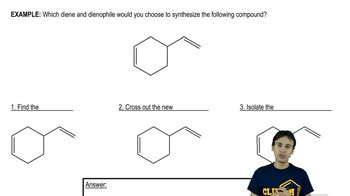
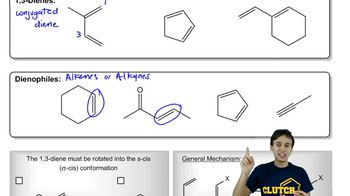
Identify the diene and the dienophile in the given Diels–Alder reaction. The diene is typically a conjugated system with four π electrons, and the dienophile is an alkene or alkyne that will react with the diene.
Examine the stereochemistry of the diene and dienophile. The Diels–Alder reaction is stereospecific, meaning that the stereochemistry of the reactants will influence the stereochemistry of the product.
Consider the electron-withdrawing groups on the dienophile. These groups can enhance the reactivity of the dienophile by making it more electrophilic, which facilitates the cycloaddition reaction.
Predict the regiochemistry of the product. The orientation of substituents in the diene and dienophile will determine the regiochemistry of the cycloaddition, often following the 'endo rule' where the major product has substituents oriented towards the larger bridge in the transition state.
Draw the resulting cyclohexene product, ensuring that you account for the stereochemistry and regiochemistry determined in the previous steps. The product will be a six-membered ring formed by the cycloaddition of the diene and dienophile.
Verified video answer for a similar problem:
This video solution was recommended by our tutors as helpful for the problem above
Video duration:
7m
Play a video:
Was this helpful?
Key Concepts
Here are the essential concepts you must grasp in order to answer the question correctly.
Diels–Alder Reaction
The Diels–Alder reaction is a [4+2] cycloaddition between a conjugated diene and a dienophile, typically forming a six-membered ring. It is a pericyclic reaction that proceeds via a concerted mechanism, meaning bonds are formed simultaneously without intermediates. Understanding the stereochemistry and regiochemistry of the reactants is crucial for predicting the product.
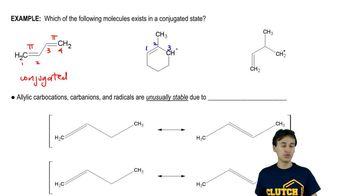
A conjugated diene consists of two double bonds separated by a single bond, allowing for electron delocalization across the π-system. This electron-rich structure is essential for the Diels–Alder reaction, as it interacts with the electron-deficient dienophile. The s-cis conformation of the diene is necessary for effective overlap of orbitals during the reaction.
A dienophile is typically an electron-deficient alkene or alkyne that reacts with a diene in the Diels–Alder reaction. The presence of electron-withdrawing groups on the dienophile enhances its reactivity by making it more electrophilic. The orientation and substituents on the dienophile influence the stereochemistry and regiochemistry of the resulting cyclohexene product.