Propose a mechanism for each of the following reactions: a.
Verified step by step guidance
1
Step 1: Analyze the reactants and reagents. The starting material is a molecule containing two ketone groups and an ester functional group. The reagent CH3MgBr is a Grignard reagent, which acts as a nucleophile, and H3O+ is used for acidic workup.
Step 2: Identify the site of nucleophilic attack. The Grignard reagent (CH3MgBr) will attack the carbonyl carbon of the ester group because esters are more reactive towards nucleophiles compared to ketones.
Step 3: Describe the nucleophilic addition. The CH3 group from CH3MgBr will add to the carbonyl carbon of the ester, breaking the C=O bond and forming a tetrahedral intermediate. The ethoxy group (-OCH2CH3) will leave as a leaving group, resulting in a ketone intermediate.
Step 4: Explain the second nucleophilic attack. The Grignard reagent will attack the newly formed ketone group, adding another CH3 group to the carbonyl carbon and forming a tertiary alcohol intermediate.
Step 5: Describe the acidic workup. The H3O+ will protonate the oxygen atoms, stabilizing the molecule and leading to the formation of the final cyclic ketone product and ethanol (CH3CH2OH) as a byproduct.
Verified video answer for a similar problem:
This video solution was recommended by our tutors as helpful for the problem above
Video duration:
5m
Play a video:
Was this helpful?
Key Concepts
Here are the essential concepts you must grasp in order to answer the question correctly.
Grignard Reagents
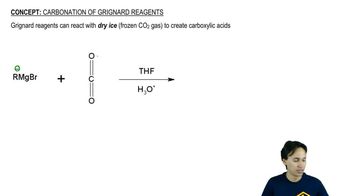
Grignard reagents are organomagnesium compounds, typically represented as R-MgX, where R is an organic group and X is a halogen. They are highly reactive nucleophiles that can add to electrophilic carbonyl groups, such as aldehydes and ketones, forming alcohols after hydrolysis. Understanding their reactivity is crucial for proposing mechanisms involving carbonyl compounds.
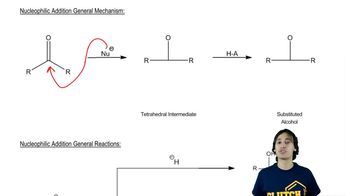
The nucleophilic addition mechanism involves the attack of a nucleophile on an electrophilic carbon atom, leading to the formation of a new bond. In the case of Grignard reagents reacting with carbonyl compounds, the nucleophile (Grignard reagent) attacks the carbonyl carbon, resulting in a tetrahedral intermediate. This step is fundamental in understanding how carbonyl compounds are converted into alcohols.
After the nucleophilic addition, the reaction typically involves protonation of the alkoxide intermediate formed. This step is crucial as it converts the alkoxide into a stable alcohol. In the provided reaction, the addition of water (H3O+) serves to protonate the alkoxide, completing the transformation of the carbonyl compound into an alcohol, which is a key outcome of the reaction.