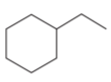
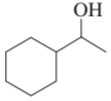
Show how the following compounds can be synthesized from cyclohexanol. a. b. c.
Verified step by step guidance
1
Step 1: Begin by analyzing the target compounds (a, b, c) and identify the functional groups or structural changes that differentiate them from cyclohexanol. For example, determine if oxidation, substitution, or elimination reactions are required.
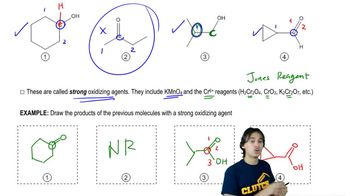
Step 2: For each target compound, determine the appropriate reaction pathway starting from cyclohexanol. For instance, if the target compound involves a ketone, consider oxidizing cyclohexanol to cyclohexanone using an oxidizing agent like PCC (Pyridinium chlorochromate).
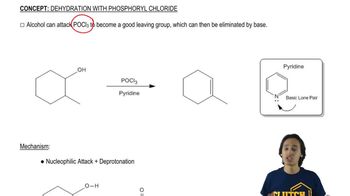
Step 3: If the target compound involves a double bond (alkene), consider performing an elimination reaction. Dehydrate cyclohexanol using a strong acid like H2SO4 to form cyclohexene via an E1 mechanism.
Step 4: If the target compound involves further functional group transformations (e.g., halogenation, epoxidation, or hydroxylation), identify the reagents and conditions required for each step. For example, cyclohexene can be brominated using Br2 to form a dibromo compound or epoxidized using mCPBA (meta-chloroperoxybenzoic acid).
Step 5: Combine all the steps into a coherent synthetic pathway for each target compound, ensuring that the reagents and conditions are compatible and that the intermediate products are stable under the reaction conditions.
Verified video answer for a similar problem:
This video solution was recommended by our tutors as helpful for the problem above
Video duration:
5m
Play a video:
Was this helpful?
Key Concepts
Here are the essential concepts you must grasp in order to answer the question correctly.
Alcohol Dehydration
Alcohol dehydration is a chemical reaction where an alcohol loses a water molecule, typically resulting in the formation of an alkene. This process often requires an acid catalyst and can occur through either an E1 or E2 mechanism, depending on the structure of the alcohol and the reaction conditions. Understanding this concept is crucial for synthesizing compounds from cyclohexanol, as it allows for the conversion of the alcohol into more reactive intermediates.
Nucleophilic substitution reactions involve the replacement of a leaving group in a molecule with a nucleophile. In the context of synthesizing compounds from cyclohexanol, this concept is essential for understanding how to convert alcohols into other functional groups, such as halides or ethers, through reactions like SN1 or SN2 mechanisms. The choice of nucleophile and reaction conditions significantly influences the outcome of the synthesis.
Nucleophiles and Electrophiles can react in Substitution Reactions.
Oxidation of Alcohols
The oxidation of alcohols is a fundamental reaction in organic chemistry where alcohols are converted into carbonyl compounds, such as aldehydes or ketones, or further to carboxylic acids. This transformation is typically achieved using oxidizing agents like potassium dichromate or PCC. Recognizing how to oxidize cyclohexanol is vital for synthesizing various target compounds, as it alters the functional groups present in the molecule.