Rank the following compounds from largest Keq to smallest Keq for hydrate formation:
Verified step by step guidance
1
Step 1: Understand the concept of hydrate formation equilibrium constant (Keq). Hydrate formation occurs when a carbonyl compound reacts with water to form a geminal diol. The equilibrium constant (Keq) for this reaction depends on the electronic and steric effects of substituents on the carbonyl group.
Step 2: Analyze the substituents on the aromatic ring for each compound. Electron-withdrawing groups (EWGs) increase the electrophilicity of the carbonyl carbon, making it more reactive toward water and increasing Keq. Electron-donating groups (EDGs) decrease electrophilicity, lowering Keq.
Step 3: Evaluate compound (A). It has a methyl group (EDG) and a carbonyl group attached to the aromatic ring. The methyl group slightly decreases the electrophilicity of the carbonyl carbon, resulting in a lower Keq compared to compounds with stronger EWGs.
Step 4: Evaluate compound (B). It has no substituents other than the aldehyde group. This compound serves as the baseline for comparison, as it lacks additional EWGs or EDGs.
Step 5: Evaluate compounds (C) and (D). Compound (C) has a sulfonic acid group (-SO3H), a strong EWG, which significantly increases the electrophilicity of the carbonyl carbon, leading to the largest Keq. Compound (D) has a methyl group (EDG), which decreases the electrophilicity of the carbonyl carbon, resulting in the smallest Keq among the compounds.
Verified video answer for a similar problem:
This video solution was recommended by our tutors as helpful for the problem above
Video duration:
8m
Play a video:
Was this helpful?
Key Concepts
Here are the essential concepts you must grasp in order to answer the question correctly.
Equilibrium Constant (Keq)
The equilibrium constant (Keq) quantifies the ratio of the concentrations of products to reactants at equilibrium for a reversible reaction. A larger Keq indicates a greater tendency for the formation of products, while a smaller Keq suggests that reactants are favored. In the context of hydrate formation, Keq helps determine which compound is more likely to form hydrates based on its structural features.
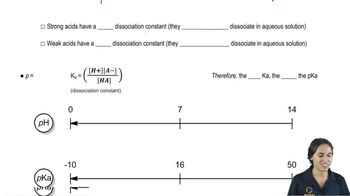
The relationship between equilibrium constant and pKa.
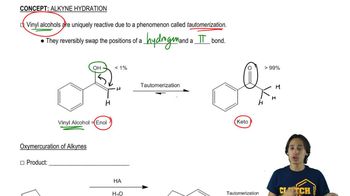
Hydration and Hydrate Formation
Hydration refers to the process where water molecules interact with solute molecules, often leading to the formation of hydrates. The stability of a hydrate is influenced by the ability of the solute to form favorable interactions with water, such as hydrogen bonding. Compounds with functional groups that can engage in strong hydrogen bonding with water typically exhibit higher Keq values for hydrate formation.
Functional groups significantly affect the chemical properties and reactivity of organic compounds. In the context of hydrate formation, groups such as hydroxyl (-OH) and sulfonic acid (-SO3H) can enhance solubility and promote hydration due to their ability to form hydrogen bonds with water. The presence and type of functional groups in the compounds A, B, C, and D will influence their respective Keq values for hydrate formation.