Vinyl alcohols are generally unstable, quickly isomerizing to carbonyl compounds. Propose mechanisms for the following isomerizations. (c)
Verified step by step guidance
1
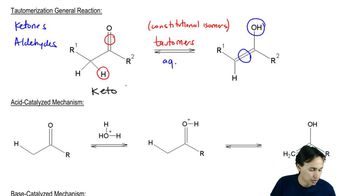
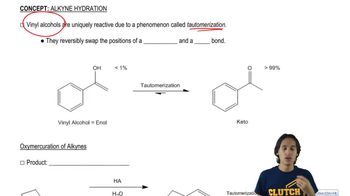
Step 1: Recognize that the vinyl alcohol (enol) isomerizes to a ketone through a keto-enol tautomerization mechanism. This process is catalyzed by either acid or base.
Step 2: In the base-catalyzed mechanism, hydroxide (-OH) acts as a catalyst. The hydroxide ion abstracts the acidic proton from the hydroxyl group of the enol, forming a negatively charged oxygen (alkoxide ion).
Step 3: The alkoxide ion then facilitates the movement of electrons, causing the double bond in the enol to shift and form a new bond with the proton that was abstracted. This results in the formation of a ketone structure.
Step 4: The ketone is stabilized due to the strong resonance stabilization of the carbonyl group, making the isomerization thermodynamically favorable.
Step 5: The reaction is reversible, but the equilibrium strongly favors the ketone form over the enol form due to the greater stability of the carbonyl compound.
Verified video answer for a similar problem:
This video solution was recommended by our tutors as helpful for the problem above
Video duration:
3m
Play a video:
Was this helpful?
Key Concepts
Here are the essential concepts you must grasp in order to answer the question correctly.
Vinyl Alcohols
Vinyl alcohols are a class of compounds characterized by the presence of a hydroxyl group (-OH) attached to a carbon-carbon double bond (C=C). They are typically unstable due to their tendency to tautomerize, which means they can readily convert to more stable forms, such as carbonyl compounds (aldehydes or ketones). This instability is a key factor in understanding their reactivity and the mechanisms involved in their isomerization.
Tautomerization is a chemical reaction that involves the rearrangement of atoms in a compound, resulting in the interconversion between two isomeric forms, typically involving a shift of a hydrogen atom and a change in the position of a double bond. In the case of vinyl alcohols, tautomerization leads to the formation of carbonyl compounds, which are generally more stable. Understanding this process is crucial for proposing mechanisms for the isomerization of vinyl alcohols.
The mechanisms of isomerization describe the step-by-step pathways through which one isomer transforms into another. For vinyl alcohols, this often involves proton transfer, bond breaking, and bond formation, leading to the conversion into carbonyl compounds. Familiarity with reaction mechanisms, including the role of catalysts and intermediates, is essential for accurately proposing and understanding the isomerization processes involved.


 3:34 minutes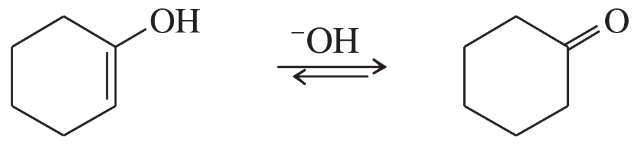
 Verified step by step guidance
 03:51
03:51