Show how you would accomplish the following syntheses. Some of these conversions may require more than one step. (c) isobutylamine → N-isobutylformamide
Verified step by step guidance
1
Identify the starting material (isobutylamine) and the target product (N-isobutylformamide). Recognize that this transformation involves converting an amine (-NH2) group into a formamide (-CONH-) group.
Understand that the formamide functional group can be introduced by reacting the amine with a formylating agent, such as formic acid (HCOOH) or formic acid derivatives like ethyl formate or formyl chloride.
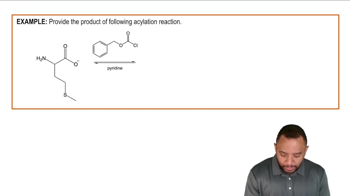
Plan the reaction: React isobutylamine with formic acid under mild heating conditions. This will lead to the formation of N-isobutylformamide through a condensation reaction, where water is eliminated.
Ensure proper reaction conditions: Use a controlled temperature to avoid overreaction or decomposition of the product. A catalyst, such as an acid, may be used to facilitate the reaction if necessary.
Verify the product: Confirm the formation of N-isobutylformamide using spectroscopic techniques such as IR (look for the C=O stretch of the formamide group) and NMR (to confirm the structure of the isobutyl group and the formamide).
Verified video answer for a similar problem:
This video solution was recommended by our tutors as helpful for the problem above
Video duration:
3m
Play a video:
Was this helpful?
Key Concepts
Here are the essential concepts you must grasp in order to answer the question correctly.
Amine Reactivity
Amines, such as isobutylamine, are organic compounds derived from ammonia by replacing one or more hydrogen atoms with alkyl or aryl groups. They can act as nucleophiles due to the lone pair of electrons on the nitrogen atom, allowing them to participate in various reactions, including acylation, where they react with carbonyl compounds to form amides.
Acylation is a chemical reaction that introduces an acyl group (RCO-) into a molecule. In the context of synthesizing N-isobutylformamide from isobutylamine, this involves the reaction of isobutylamine with formic acid or an acyl chloride, leading to the formation of an amide. This reaction is crucial for converting amines into more complex structures.
Functional group transformation refers to the process of converting one functional group into another through chemical reactions. In this synthesis, the transformation of the amine group in isobutylamine to the amide group in N-isobutylformamide exemplifies this concept, highlighting the importance of understanding how different functional groups behave and react in organic chemistry.