Predict the products of the following aldol condensations. Show the products both before and after dehydration. (f)
Verified step by step guidance
1
Step 1: Identify the reactants and the type of reaction. The given reaction involves an aldol condensation, where the enolate ion formed from one carbonyl compound reacts with another carbonyl compound to form a β-hydroxy ketone or aldehyde.
Step 2: Determine the enolate formation. In the presence of a base (−OH), the α-hydrogen of the ketone is abstracted, forming an enolate ion. The enolate ion is nucleophilic at the α-carbon.
Step 3: Perform the nucleophilic attack. The enolate ion attacks the carbonyl carbon of another molecule of the ketone, forming a new C-C bond. This results in the formation of a β-hydroxy ketone intermediate.
Step 4: Analyze the dehydration step. Under the reaction conditions, the β-hydroxy ketone undergoes dehydration (loss of water) to form an α,β-unsaturated ketone. This elimination typically occurs via an E1cB mechanism, where the hydroxide ion is eliminated first, followed by the proton from the α-carbon.
Step 5: Predict the final product. After dehydration, the product will be an α,β-unsaturated ketone. The structure of the product can be determined by considering the position of the double bond formed during the elimination step.
Verified video answer for a similar problem:
This video solution was recommended by our tutors as helpful for the problem above
Video duration:
5m
Play a video:
0 Comments
Key Concepts
Here are the essential concepts you must grasp in order to answer the question correctly.
Aldol Condensation
Aldol condensation is a reaction between aldehydes or ketones that contain at least one alpha-hydrogen. In this reaction, one molecule acts as a nucleophile and attacks the carbonyl carbon of another molecule, forming a beta-hydroxy aldehyde or ketone. This intermediate can then undergo dehydration to yield an α,β-unsaturated carbonyl compound, which is often the final product.
Dehydration in aldol reactions refers to the elimination of a water molecule from the beta-hydroxy aldehyde or ketone intermediate. This step is crucial as it leads to the formation of a more stable α,β-unsaturated carbonyl compound. The dehydration typically occurs under heat or acidic/basic conditions, enhancing the reaction's driving force by increasing the stability of the product.
Regioselectivity and stereochemistry are important considerations in aldol condensations, as they determine the specific products formed. Regioselectivity refers to the preference for the formation of one constitutional isomer over another, while stereochemistry involves the spatial arrangement of atoms in the product. Understanding these concepts helps predict the major products and their configurations in complex aldol reactions.


 5:57 minutes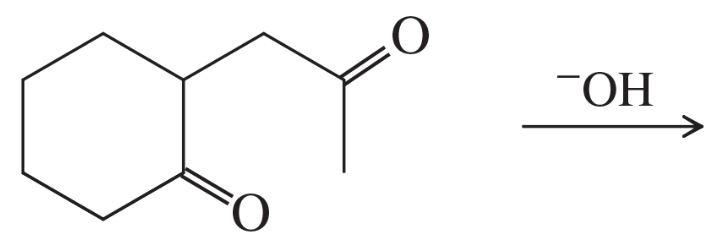
 Verified step by step guidance
 09:51
09:51
