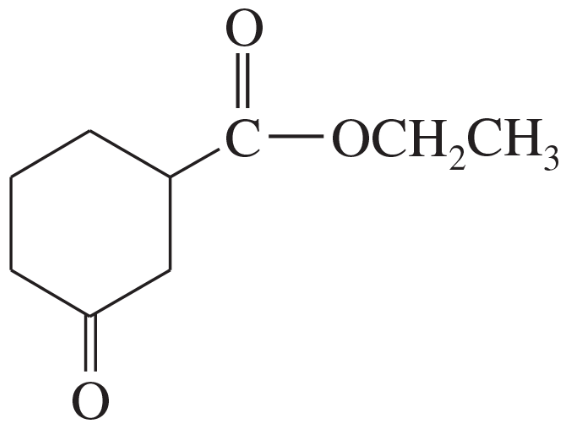
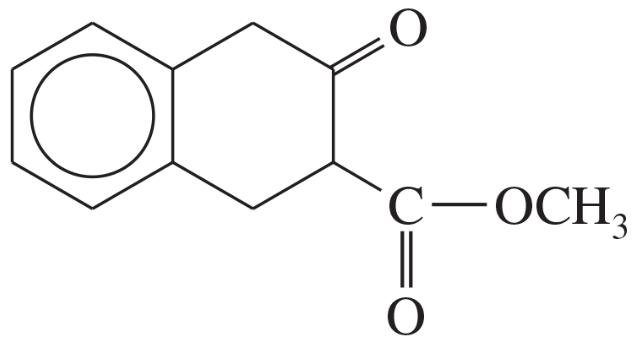
Some (but not all) of the following keto esters can be formed by Dieckmann condensations. Determine which ones are possible, and draw the starting diesters. (a) (b)
Verified step by step guidance
1
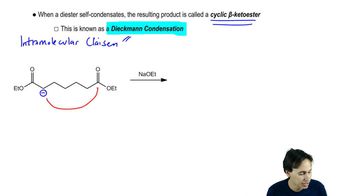
Step 1: Understand the Dieckmann condensation reaction. The Dieckmann condensation is an intramolecular Claisen condensation where a diester reacts with a base to form a cyclic β-keto ester. This reaction typically forms 5- or 6-membered rings due to favorable ring strain considerations.
Step 2: Analyze the given keto esters. For each keto ester, determine whether it can form a 5- or 6-membered ring upon cyclization. If the structure of the keto ester suggests a ring size outside this range, it is unlikely to form via a Dieckmann condensation.
Step 3: Identify the starting diester for each keto ester. To do this, reverse the Dieckmann condensation mechanism. Break the β-keto ester at the bond between the α-carbon and the carbonyl carbon of the ester group. Add an ester group to the α-carbon to reconstruct the starting diester.
Step 4: Verify the feasibility of the reaction. Check whether the starting diester can undergo an intramolecular reaction to form the desired cyclic β-keto ester. Ensure that the reaction conditions (e.g., base and solvent) would favor the formation of the product.
Step 5: Draw the starting diesters for the keto esters that can be formed via Dieckmann condensation. For those that cannot be formed, provide a brief explanation of why the reaction is not feasible (e.g., ring strain or improper positioning of ester groups).
Verified video answer for a similar problem:
This video solution was recommended by our tutors as helpful for the problem above
Play a video:
Was this helpful?
Key Concepts
Here are the essential concepts you must grasp in order to answer the question correctly.
Dieckmann Condensation
Dieckmann condensation is a specific type of intramolecular aldol reaction that occurs between two ester groups in the presence of a strong base. This reaction typically leads to the formation of a β-keto ester. Understanding the mechanism involves recognizing how the base deprotonates the ester, allowing for nucleophilic attack on the carbonyl carbon of another ester group, ultimately forming a cyclic product.
Keto esters are organic compounds that contain both a ketone and an ester functional group. They are characterized by the presence of a carbonyl group (C=O) adjacent to an ester group (RCOOR'). The formation of keto esters through Dieckmann condensation is significant in organic synthesis, as they can serve as intermediates for further reactions, including cyclization and functional group transformations.
Starting diesters are the initial compounds required for the Dieckmann condensation reaction. They typically consist of two ester groups separated by a carbon chain. The structure and length of this chain are crucial, as they determine the feasibility of the intramolecular reaction and the formation of a cyclic product. Identifying the correct starting diesters is essential for predicting which keto esters can be synthesized through this method.