Draw structures of the following derivatives. (h) the hemiacetal form of 5-hydroxypentanal
Verified step by step guidance
1
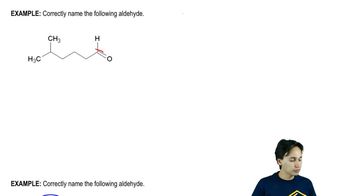
Understand the structure of 5-hydroxypentanal: It is a five-carbon aldehyde with a hydroxyl (-OH) group attached to the fifth carbon. The aldehyde group (-CHO) is located at the first carbon.
Recall the definition of a hemiacetal: A hemiacetal is formed when an alcohol (-OH) group reacts with an aldehyde group. This reaction results in a carbon atom bonded to one -OH group and one -OR group (where R is an alkyl or hydrogen).
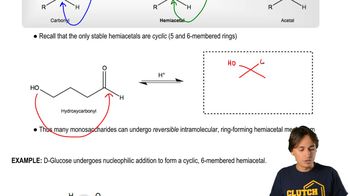
Identify the intramolecular reaction: In 5-hydroxypentanal, the hydroxyl group on the fifth carbon can react with the aldehyde group on the first carbon to form a cyclic hemiacetal. This is possible because the molecule has the appropriate chain length for cyclization.
Draw the cyclic structure: The reaction forms a five-membered ring (a cyclic hemiacetal). The oxygen from the hydroxyl group becomes part of the ring, and the first carbon (from the aldehyde group) is now bonded to both the ring oxygen and a hydroxyl group.
Verify the structure: Ensure that the cyclic hemiacetal has the correct connectivity. The first carbon should have a hydroxyl group (-OH) and be part of the ring, while the fifth carbon retains its original substituents. Check for proper stereochemistry if applicable.
Verified video answer for a similar problem:
This video solution was recommended by our tutors as helpful for the problem above
Video duration:
3m
Play a video:
Was this helpful?
Key Concepts
Here are the essential concepts you must grasp in order to answer the question correctly.
Hemiacetals
Hemiacetals are organic compounds formed when an aldehyde or ketone reacts with an alcohol. They contain one hydroxyl group (-OH) and one alkoxy group (-O-R) attached to the same carbon atom, which is typically the carbonyl carbon. Hemiacetals are important intermediates in the formation of acetals and are often found in carbohydrate chemistry.
Aldehydes are characterized by the presence of a carbonyl group (C=O) at the end of a carbon chain. In the case of 5-hydroxypentanal, the structure includes a five-carbon chain with a hydroxyl group (-OH) on the fifth carbon and an aldehyde functional group at the first carbon. Understanding the structure of aldehydes is crucial for predicting their reactivity and the formation of derivatives like hemiacetals.
Stereochemistry refers to the study of the spatial arrangement of atoms in molecules and how this affects their chemical behavior. In the case of hemiacetals, the formation can lead to the creation of chiral centers, resulting in different stereoisomers. Recognizing stereochemical configurations is essential for accurately drawing and understanding the structures of organic compounds.