
Show how an acetoacetic ester synthesis might be used to form a δ-diketone such as heptane-2,6-dione.
Verified step by step guidance
1
Identify the starting material for the acetoacetic ester synthesis. The key reagent is ethyl acetoacetate (CH₃COCH₂COOEt), which contains both a ketone and an ester functional group, making it a versatile compound for this reaction.
Determine the alkyl halides needed to form the δ-diketone. In this case, the target molecule, heptane-2,6-dione, suggests that two alkyl groups (ethyl groups) need to be added to the central carbon of ethyl acetoacetate.
Perform the first alkylation. Deprotonate the methylene group (CH₂) of ethyl acetoacetate using a strong base such as sodium ethoxide (NaOEt) to form an enolate ion. Then, react the enolate with ethyl bromide (C₂H₅Br) to add the first ethyl group.
Perform the second alkylation. Repeat the process by deprotonating the remaining methylene hydrogen of the monoalkylated product with a strong base, forming a new enolate ion. React this enolate with another equivalent of ethyl bromide to add the second ethyl group.
Hydrolyze and decarboxylate the diethylated product. Treat the compound with aqueous acid (H₃O⁺) to hydrolyze the ester group to a carboxylic acid. Then, heat the resulting β-keto acid to induce decarboxylation, yielding the desired δ-diketone, heptane-2,6-dione.
Verified video answer for a similar problem:
This video solution was recommended by our tutors as helpful for the problem above
Video duration:
9m
Play a video:
Was this helpful?
Key Concepts
Here are the essential concepts you must grasp in order to answer the question correctly.
Acetoacetic Ester Synthesis
Acetoacetic ester synthesis is a method for forming ketones through the reaction of an acetoacetic ester with an alkyl halide. This process involves the enolate ion of the acetoacetic ester attacking the alkyl halide, leading to the formation of a new carbon-carbon bond. The resulting product can be hydrolyzed and decarboxylated to yield a diketone, making it a valuable reaction in organic synthesis.
Synthesis of Amino Acids: Acetamidomalonic Ester Synthesis Example 2
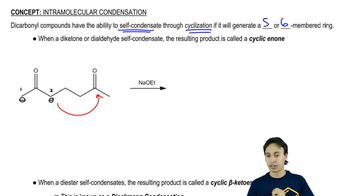
Diketones
Diketones are organic compounds that contain two carbonyl groups (C=O) within the same molecule. They can exhibit unique chemical properties and reactivity due to the presence of these functional groups. In the case of heptane-2,6-dione, the diketone structure allows for various synthetic applications, including the formation of complex molecules and intermediates in organic chemistry.
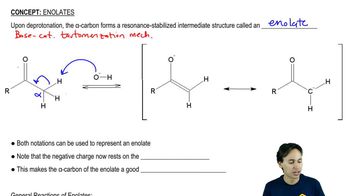
Enolate chemistry involves the formation and reactivity of enolate ions, which are generated from carbonyl compounds through deprotonation. These enolate ions are nucleophilic and can participate in various reactions, such as alkylation and condensation. Understanding enolate chemistry is crucial for acetoacetic ester synthesis, as it enables the formation of new carbon-carbon bonds necessary for constructing diketones like heptane-2,6-dione.