Lawsone, found in the extract of henna, reacts with amino acid residues to give the characteristic color associated with henna tattoos. Suggest a mechanism for the reaction shown.
Verified step by step guidance
1
Step 1: Analyze the reactants and products. Lawsone contains a hydroxyl group (-OH) and a ketone group in a quinone structure. The amino acid residue has an amine group (-NH2) and a carboxylic acid group (-COOH). The product shows the formation of a bond between the nitrogen of the amino group and the carbon of the quinone structure in lawsone.
Step 2: Recognize the type of reaction. This is a nucleophilic addition-elimination reaction where the amino group (-NH2) acts as a nucleophile and attacks the electrophilic carbonyl carbon of the quinone structure in lawsone.
Step 3: Initiate the mechanism. The lone pair of electrons on the nitrogen of the amino group attacks the electrophilic carbonyl carbon of lawsone, forming a tetrahedral intermediate. This step is driven by the high electrophilicity of the quinone carbonyl group.
Step 4: Eliminate a leaving group. The tetrahedral intermediate collapses, leading to the elimination of the hydroxyl group (-OH) from lawsone. This results in the formation of a covalent bond between the nitrogen of the amino group and the quinone carbon.
Step 5: Finalize the product. The resulting structure is stabilized by resonance within the quinone ring system, and the amino acid residue is now covalently bonded to lawsone, forming the characteristic product seen in henna tattoos.
Verified video answer for a similar problem:
This video solution was recommended by our tutors as helpful for the problem above
Play a video:
Was this helpful?
Key Concepts
Here are the essential concepts you must grasp in order to answer the question correctly.
Nucleophilic Attack
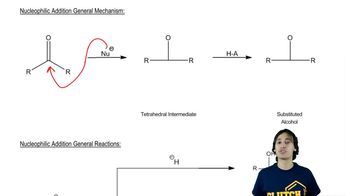
In organic chemistry, a nucleophilic attack occurs when a nucleophile, which is a species with a high electron density, donates an electron pair to an electrophile, a species with a low electron density. In the context of the reaction between lawsone and amino acid residues, the amino group of the amino acid acts as a nucleophile, attacking the electrophilic carbon in the lawsone molecule, leading to the formation of a new bond.
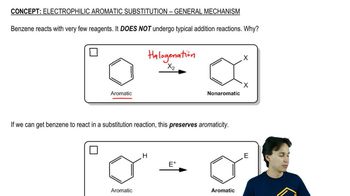
Electrophilic aromatic substitution is a fundamental reaction mechanism in organic chemistry where an electrophile replaces a hydrogen atom on an aromatic ring. In the case of lawsone, which contains an aromatic system, the reaction with amino acids may involve the substitution of a hydrogen atom on the aromatic ring, contributing to the color change associated with henna tattoos.
Resonance stabilization refers to the delocalization of electrons in a molecule, which can enhance its stability. In the reaction involving lawsone, the formation of resonance structures can stabilize the intermediate species formed during the nucleophilic attack, making the reaction more favorable and influencing the final color of the henna tattoo.