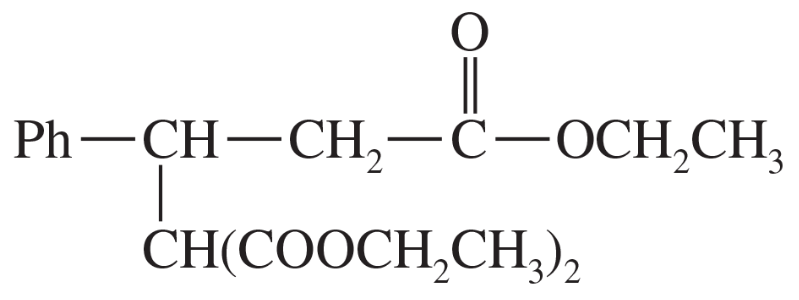
Show how the following products might be synthesized from suitable Michael donors and acceptors. (a)
Verified step by step guidance
1
Step 1: Identify the product as a 1,5-dicarbonyl compound, which is characteristic of a Michael addition reaction. The structure contains two ketone groups and one ester group, indicating the involvement of a Michael donor and acceptor.
Step 2: Select a suitable Michael donor. A common Michael donor is a compound with an active methylene group, such as diethyl malonate or ethyl acetoacetate. These compounds have acidic hydrogens that can be deprotonated to form a nucleophilic enolate.
Step 3: Select a suitable Michael acceptor. A Michael acceptor typically contains an α,β-unsaturated carbonyl group, such as methyl vinyl ketone or cinnamaldehyde. These compounds have an electrophilic β-carbon due to conjugation with the carbonyl group.
Step 4: Perform the Michael addition reaction. The enolate formed from the Michael donor attacks the β-carbon of the Michael acceptor, forming a new carbon-carbon bond. This step results in the formation of the 1,5-dicarbonyl intermediate.
Step 5: Analyze the substituents on the product to determine the specific Michael donor and acceptor used. For example, the phenyl groups in the product suggest that the Michael acceptor could be benzylideneacetone or a similar compound, while the ethoxy group indicates that the Michael donor could be ethyl acetoacetate.
Verified video answer for a similar problem:
This video solution was recommended by our tutors as helpful for the problem above
Video duration:
8m
Play a video:
Was this helpful?
Key Concepts
Here are the essential concepts you must grasp in order to answer the question correctly.
Michael Addition
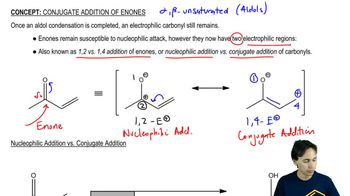
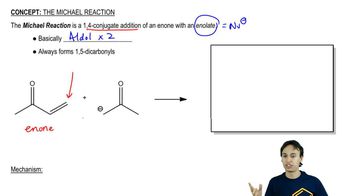
Michael addition is a nucleophilic addition reaction where a nucleophile adds to an α,β-unsaturated carbonyl compound. This reaction typically involves a Michael donor, such as an enolate ion or a stabilized carbanion, which attacks the electrophilic β-carbon of the unsaturated system, forming a new carbon-carbon bond. Understanding this mechanism is crucial for synthesizing complex organic molecules.
In the context of Michael addition, Michael donors are nucleophiles that can donate a pair of electrons, while Michael acceptors are electrophiles that can accept those electrons. Common Michael donors include enolates and certain stabilized carbanions, while typical acceptors are α,β-unsaturated carbonyl compounds. Identifying suitable donors and acceptors is essential for predicting the products of the reaction.
Synthesis strategies in organic chemistry involve planning and executing a series of chemical reactions to construct a desired compound. This includes selecting appropriate starting materials, reaction conditions, and purification methods. In the case of the given question, understanding how to combine Michael donors and acceptors effectively is key to synthesizing the target products shown in the image.