Predict the products formed when cyclohexanone reacts with the following reagents. (e) phenylhydrazine and weak acid
Verified step by step guidance
1
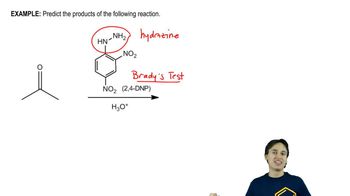
Step 1: Recognize the type of reaction. Cyclohexanone is a ketone, and phenylhydrazine reacts with ketones in the presence of a weak acid to form hydrazones. This is a condensation reaction where the carbonyl group of the ketone reacts with the hydrazine derivative.
Step 2: Write the general reaction mechanism. The carbonyl group (C=O) of cyclohexanone undergoes nucleophilic attack by the nitrogen atom of phenylhydrazine. This forms an intermediate where the oxygen is protonated by the weak acid.
Step 3: Eliminate water. After the intermediate is formed, a dehydration step occurs, where a molecule of water is eliminated. This results in the formation of a double bond between the carbon of the former carbonyl group and the nitrogen of phenylhydrazine.
Step 4: Represent the product. The final product is a cyclohexanone phenylhydrazone, where the phenyl group (C₆H₅) is attached to the nitrogen atom, and the nitrogen is double-bonded to the carbon of the former carbonyl group.
Step 5: Verify the reaction conditions. Ensure that the reaction occurs under weakly acidic conditions, as the acid catalyzes the dehydration step and stabilizes the intermediate during the reaction.
Verified video answer for a similar problem:
This video solution was recommended by our tutors as helpful for the problem above
Video duration:
3m
Play a video:
Was this helpful?
Key Concepts
Here are the essential concepts you must grasp in order to answer the question correctly.
Cyclohexanone Structure and Reactivity
Cyclohexanone is a cyclic ketone with a six-membered carbon ring and a carbonyl group (C=O). Its reactivity is primarily due to the electrophilic nature of the carbonyl carbon, which can undergo nucleophilic addition reactions. Understanding its structure helps predict how it will interact with various reagents, such as phenylhydrazine.
Phenylhydrazine is an organic compound commonly used to form hydrazones with carbonyl compounds. It acts as a nucleophile, attacking the electrophilic carbonyl carbon of ketones and aldehydes. This reaction is significant in organic synthesis and can be used to identify carbonyl-containing compounds through the formation of stable derivatives.
Weak acids can facilitate the reaction between phenylhydrazine and cyclohexanone by protonating the carbonyl oxygen, increasing the electrophilicity of the carbonyl carbon. This acid-catalyzed mechanism is crucial for enhancing the nucleophilic attack and ensuring the successful formation of the hydrazone product.