Draw a mechanism for the reaction of propanoyl chloride with 2 moles of phenylmagnesium bromide.
Verified step by step guidance
1
Identify the reactants: Propanoyl chloride (CH3CH2COCl) is an acid chloride, and phenylmagnesium bromide (C6H5MgBr) is a Grignard reagent. Grignard reagents are nucleophiles that react with electrophiles like acid chlorides.
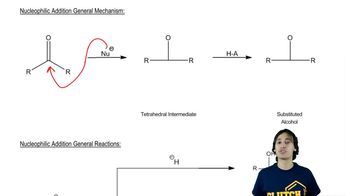
Understand the reaction mechanism: The reaction proceeds in two steps. In the first step, the nucleophilic phenyl group (C6H5-) from phenylmagnesium bromide attacks the carbonyl carbon of propanoyl chloride, forming a tetrahedral intermediate.
Account for the leaving group: The tetrahedral intermediate collapses, expelling the chloride ion (Cl-) as a leaving group. This results in the formation of a ketone, specifically propiophenone (CH3CH2COC6H5).
Introduce the second mole of phenylmagnesium bromide: The ketone (propiophenone) reacts with the second mole of phenylmagnesium bromide. The phenyl group (C6H5-) attacks the carbonyl carbon again, forming another tetrahedral intermediate.
Complete the reaction: The tetrahedral intermediate is protonated during the acidic workup step, resulting in the formation of a tertiary alcohol, specifically 1,1-diphenylpropan-2-ol (CH3CH(C6H5)2OH).
Verified video answer for a similar problem:
This video solution was recommended by our tutors as helpful for the problem above
Video duration:
7m
Play a video:
Was this helpful?
Key Concepts
Here are the essential concepts you must grasp in order to answer the question correctly.
Grignard Reagents
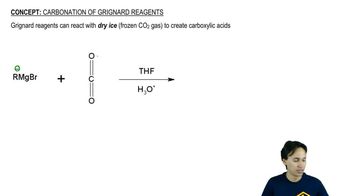
Grignard reagents, such as phenylmagnesium bromide, are organomagnesium compounds that act as nucleophiles in organic reactions. They are formed by the reaction of an alkyl or aryl halide with magnesium metal in dry ether. Grignard reagents can react with carbonyl compounds to form alcohols, making them essential in nucleophilic addition reactions.
The nucleophilic addition mechanism involves the attack of a nucleophile on an electrophilic carbon atom, typically found in carbonyl groups. In this case, the carbonyl carbon of propanoyl chloride is attacked by the nucleophilic phenylmagnesium bromide, leading to the formation of a tetrahedral intermediate. This step is crucial for understanding how the reaction proceeds and ultimately leads to the formation of a new carbon-carbon bond.
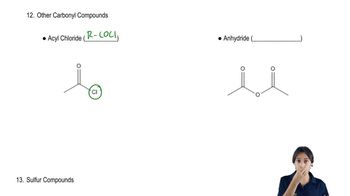
Acyl chlorides, like propanoyl chloride, are reactive carbonyl compounds that contain a chlorine atom bonded to the carbonyl carbon. They are highly electrophilic and readily undergo nucleophilic attack due to the electron-withdrawing effect of the chlorine atom. Understanding the reactivity of acyl chlorides is vital for predicting the outcome of reactions involving these compounds, especially in the presence of strong nucleophiles like Grignard reagents.