Suggest a series of steps involving a cuprate reagent that would convert the reactant on the left to the product on the right. The ideal number of steps is shown. (b)
Verified step by step guidance
1
Step 1: Identify the functional groups in the reactant and product. The reactant contains an ester group attached to a pyrrole ring, while the product has an additional alkyl group attached to the pyrrole ring.
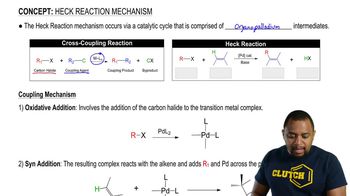
Step 2: Recognize that a cuprate reagent can be used for conjugate addition to introduce an alkyl group. Cuprate reagents are typically organocopper compounds, such as R2CuLi, where R is an alkyl group.
Step 3: Use the cuprate reagent to perform a conjugate addition to the pyrrole ring. This involves the nucleophilic attack of the cuprate reagent on the electrophilic site of the pyrrole ring, resulting in the formation of a new carbon-carbon bond.
Step 4: Consider the stereochemistry and regiochemistry of the addition. Ensure that the alkyl group is added to the correct position on the pyrrole ring as indicated in the product structure.
Step 5: Perform any necessary work-up steps to isolate and purify the product, such as quenching the reaction, washing, and drying the organic layer.
Verified video answer for a similar problem:
This video solution was recommended by our tutors as helpful for the problem above
Play a video:
0 Comments
Key Concepts
Here are the essential concepts you must grasp in order to answer the question correctly.
Cuprate Reagents
Cuprate reagents, typically organocuprates, are organometallic compounds containing copper. They are highly nucleophilic and are commonly used in organic synthesis to form carbon-carbon bonds. Cuprates can react with various electrophiles, making them versatile in transforming functional groups in organic molecules.
Nucleophilic substitution is a fundamental reaction mechanism in organic chemistry where a nucleophile attacks an electrophile, replacing a leaving group. This process is crucial for converting functional groups and is often categorized into two main types: SN1 and SN2, depending on the reaction conditions and the structure of the substrate.
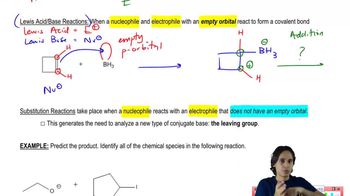
Nucleophiles and Electrophiles can react in Substitution Reactions.
Reaction Mechanism
A reaction mechanism describes the step-by-step sequence of elementary reactions by which overall chemical change occurs. Understanding the mechanism is essential for predicting the products of a reaction, optimizing conditions, and designing synthetic pathways. Each step in a mechanism involves specific interactions between reactants, intermediates, and products.


 Verified step by step guidance
 01:52
01:52