
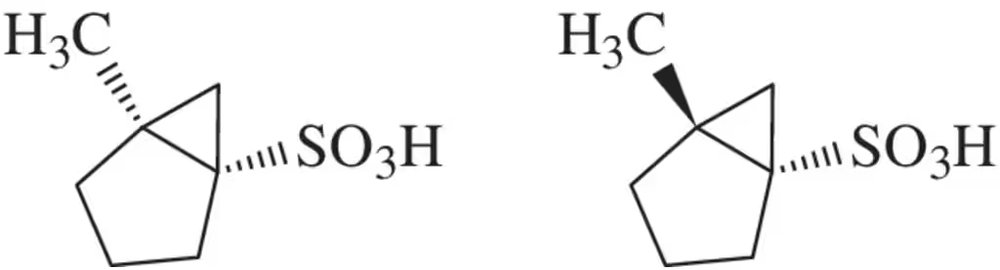
In contrast to Assessment 6.63, the following compounds should be easily separable using standard methods. Why?
Verified step by step guidance
1
Identify the compounds in question and determine their physical and chemical properties, such as boiling points, solubility, polarity, and functional groups. These properties are key to understanding why they are easily separable.
Consider the standard separation methods available, such as distillation, extraction, chromatography, or recrystallization. Match the properties of the compounds to the most appropriate separation technique.
For example, if the compounds have significantly different boiling points, fractional distillation would be an effective method. If they differ in polarity, liquid-liquid extraction or chromatography could be used.
Analyze the structural differences between the compounds. For instance, if one compound is polar and the other is nonpolar, they can be separated using a polar solvent in an extraction process.
Conclude by explaining how the differences in the compounds' properties make them easily separable using the chosen method, contrasting this with the challenges faced in Assessment 6.63, where the compounds likely had more similar properties.
Verified video answer for a similar problem:
This video solution was recommended by our tutors as helpful for the problem above
Video duration:
2m
Play a video:
Was this helpful?
Key Concepts
Here are the essential concepts you must grasp in order to answer the question correctly.
Separation Techniques
Separation techniques in organic chemistry, such as distillation, chromatography, and extraction, are methods used to isolate compounds from mixtures. The effectiveness of these techniques often depends on the physical and chemical properties of the compounds, such as boiling points, polarity, and solubility. Understanding these properties helps predict how easily compounds can be separated.
Polarity refers to the distribution of electrical charge over the atoms in a molecule. Polar compounds have a significant difference in electronegativity between atoms, leading to partial positive and negative charges. This property affects solubility and interaction with solvents, which is crucial for separation methods like chromatography, where polar and nonpolar compounds behave differently.
The boiling point of a compound is the temperature at which it transitions from liquid to gas. Compounds with significantly different boiling points can be separated effectively through distillation, as they vaporize at different temperatures. Understanding the boiling points of the compounds in question is essential for predicting their separability using standard methods.