Draw the four stereoisomers of 1,3-dichloro-2-pentanol using b. perspective formulas.
Verified step by step guidance
1
Identify the chiral centers in 1,3-dichloro-2-pentanol. The molecule has two chiral centers: one at carbon-2 (due to the hydroxyl group) and one at carbon-3 (due to the chlorine atom).
Determine the possible stereoisomers. Since there are two chiral centers, the molecule can have 2^2 = 4 stereoisomers. These include combinations of R and S configurations at each chiral center (R,R; R,S; S,R; S,S).
Draw the carbon backbone of 1,3-dichloro-2-pentanol. Start with a five-carbon chain, ensuring the hydroxyl group (-OH) is attached to carbon-2 and chlorine atoms are attached to carbons-1 and -3.
Use perspective formulas to represent the stereochemistry. For each stereoisomer, use wedge (solid triangle) and dash (dashed line) bonds to indicate the spatial arrangement of substituents around the chiral centers. For example, a wedge bond indicates a group coming out of the plane, while a dashed bond indicates a group going behind the plane.
Label each stereoisomer with its specific configuration (R or S) at each chiral center. Assign priorities to the substituents around each chiral center using the Cahn-Ingold-Prelog rules, and determine the configuration by tracing the priority order.
Verified video answer for a similar problem:
This video solution was recommended by our tutors as helpful for the problem above
Video duration:
2m
Play a video:
Was this helpful?
Key Concepts
Here are the essential concepts you must grasp in order to answer the question correctly.
Stereoisomerism
Stereoisomerism refers to the phenomenon where compounds have the same molecular formula and connectivity of atoms but differ in the spatial arrangement of their atoms. This can lead to different physical and chemical properties. In the case of 1,3-dichloro-2-pentanol, stereoisomers arise due to the presence of chiral centers, which can exist in different configurations.
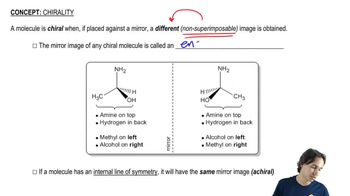
Chirality is a property of a molecule that makes it non-superimposable on its mirror image, much like left and right hands. A chiral center, typically a carbon atom bonded to four different groups, gives rise to two enantiomers. In 1,3-dichloro-2-pentanol, the presence of chiral centers at the second carbon leads to the formation of stereoisomers that can be represented in perspective formulas.
Perspective formulas are a way to represent three-dimensional structures of molecules on a two-dimensional surface. They use lines and wedges to indicate the orientation of bonds: solid lines for bonds in the plane, dashed lines for bonds going behind the plane, and wedges for bonds coming out of the plane. This representation is crucial for visualizing stereoisomers, as it helps to distinguish between different spatial arrangements of atoms.