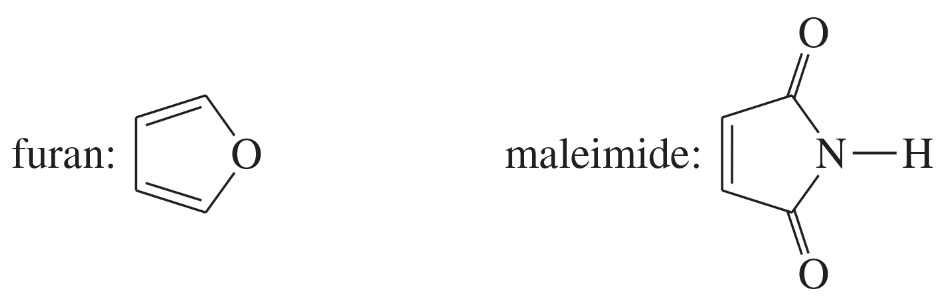
Furan and maleimide undergo a Diels–Alder reaction at 25 °C to give the endo isomer of the product. When the reaction takes place at 90 °C, however, the major product is the exo isomer. Further study shows that the endo isomer of the product isomerizes to the exo isomer at 90 °C. c. Examine your answer to (b) and determine whether this answer applies to a reaction that is kinetically controlled or one that is thermodynamically controlled, or both.
Verified step by step guidance
1
Step 1: Understand the Diels–Alder reaction mechanism. The Diels–Alder reaction is a [4+2] cycloaddition between a conjugated diene (furan) and a dienophile (maleimide). This reaction forms a cyclic adduct, and the stereochemistry of the product depends on reaction conditions.
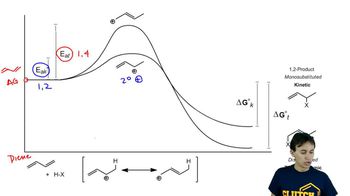
Step 2: Analyze the temperature-dependent product formation. At 25 °C, the reaction produces the endo isomer as the major product. This suggests that the reaction is under kinetic control, where the endo product forms faster due to favorable secondary orbital interactions between the diene and dienophile.
Step 3: Examine the product at 90 °C. At higher temperatures, the major product is the exo isomer. This indicates that the reaction is under thermodynamic control, where the exo isomer is more stable and forms preferentially due to its lower steric hindrance compared to the endo isomer.
Step 4: Consider the isomerization of the endo product to the exo product at 90 °C. The fact that the endo isomer can isomerize to the exo isomer at elevated temperatures further supports the idea that the exo isomer is the thermodynamically favored product.
Step 5: Conclude the type of control. The reaction at 25 °C is kinetically controlled, favoring the endo isomer due to faster formation. The reaction at 90 °C is thermodynamically controlled, favoring the exo isomer due to its greater stability. Both kinetic and thermodynamic control apply, but at different temperatures.
Verified video answer for a similar problem:
This video solution was recommended by our tutors as helpful for the problem above
Video duration:
1m
Play a video:
Was this helpful?
Key Concepts
Here are the essential concepts you must grasp in order to answer the question correctly.
Diels–Alder Reaction
The Diels–Alder reaction is a [4+2] cycloaddition between a diene and a dienophile, forming a six-membered ring. This reaction is stereospecific, meaning the stereochemistry of the reactants influences the stereochemistry of the products. In this case, furan acts as the diene and maleimide as the dienophile, leading to the formation of endo and exo isomers depending on the reaction conditions.
Kinetic control refers to reactions that are governed by the rate at which products form, typically favoring the formation of the more stable transition state. In contrast, thermodynamic control is determined by the stability of the products, favoring the more stable product at equilibrium. The temperature influences which control is dominant; lower temperatures often favor kinetic products, while higher temperatures favor thermodynamic products.
Isomerization is the process by which one molecule is transformed into another molecule with the same atoms but in a different arrangement. In the context of the Diels–Alder reaction, the endo isomer can isomerize to the exo isomer at elevated temperatures, indicating that the exo isomer is thermodynamically more stable. This transformation is crucial for understanding the product distribution based on reaction conditions.