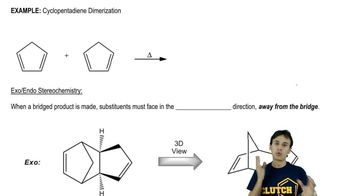
Cyclopentadiene can react with itself in a Diels–Alder reaction. Draw the endo and exo products.
Verified step by step guidance
1
Identify the components of the Diels–Alder reaction: Cyclopentadiene acts as both the diene (a conjugated system with alternating double and single bonds) and the dienophile (a molecule with a double or triple bond that reacts with the diene).
Draw the structure of cyclopentadiene, ensuring you represent the conjugated diene system (two double bonds separated by a single bond). Label one molecule as the diene and the other as the dienophile.
Orient the two cyclopentadiene molecules so that the diene's π-electrons can overlap with the dienophile's π-electrons. This overlap forms a new six-membered ring in the product.
Apply the endo rule: In the endo product, substituents on the dienophile (in this case, the second cyclopentadiene molecule) are oriented towards the π-system of the diene. Draw the resulting six-membered ring with the appropriate stereochemistry.
Draw the exo product: In the exo product, substituents on the dienophile are oriented away from the π-system of the diene. Again, draw the six-membered ring with the correct stereochemistry.
Verified video answer for a similar problem:
This video solution was recommended by our tutors as helpful for the problem above
Video duration:
8m
Play a video:
Was this helpful?
Key Concepts
Here are the essential concepts you must grasp in order to answer the question correctly.
Diels–Alder Reaction
The Diels–Alder reaction is a [4+2] cycloaddition reaction between a conjugated diene and a dienophile, resulting in the formation of a six-membered ring. This reaction is a key method in organic synthesis for constructing cyclic compounds and is characterized by its stereospecificity and regioselectivity.
In the context of the Diels–Alder reaction, endo and exo refer to the relative orientation of substituents on the newly formed ring. The endo product has substituents oriented towards the larger bridge of the bicyclic structure, while the exo product has them oriented away, influencing the stability and reactivity of the products.
Stereochemistry is the study of the spatial arrangement of atoms in molecules and how this affects their chemical behavior. In the Diels–Alder reaction, understanding stereochemistry is crucial for predicting the formation of endo and exo products, as the orientation of substituents can lead to different physical and chemical properties.