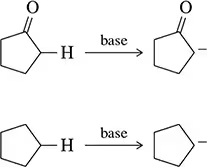
Which of the following reactions would you expect to be faster/more favorable in each pair? Why? (c)
Verified step by step guidance
1
Identify the functional groups in each reaction. The first reaction involves a ketone, while the second involves an aldehyde.
Recall that aldehydes are generally more reactive than ketones due to less steric hindrance and the electron-withdrawing effect of the carbonyl group being more pronounced.
Consider the role of the base in the reaction. The base will likely deprotonate the alpha hydrogen, leading to the formation of an enolate ion.
Compare the acidity of the alpha hydrogens in both compounds. The alpha hydrogen in the aldehyde is more acidic than in the ketone, making it easier to deprotonate.
Conclude that the reaction involving the aldehyde is expected to be faster/more favorable due to the higher reactivity and acidity of the alpha hydrogen compared to the ketone.
Verified video answer for a similar problem:
This video solution was recommended by our tutors as helpful for the problem above
Play a video:
Was this helpful?
Key Concepts
Here are the essential concepts you must grasp in order to answer the question correctly.
Aldol Condensation
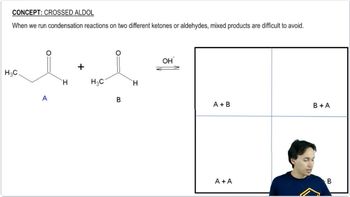
Aldol condensation is a reaction where enolates, formed from aldehydes or ketones, react with carbonyl compounds to form β-hydroxy ketones or aldehydes. This reaction is base-catalyzed and involves the formation of a new carbon-carbon bond. Understanding the stability of the enolate ion and the electrophilicity of the carbonyl carbon is crucial for predicting the reaction's favorability.
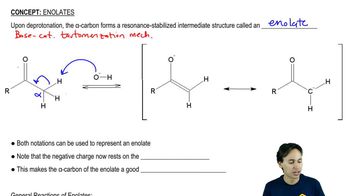
Enolate ions are formed when a base abstracts an alpha hydrogen from a carbonyl compound, resulting in a resonance-stabilized anion. The acidity of the alpha hydrogen and the strength of the base influence the formation of enolates. In the given reactions, the presence of a carbonyl group increases the acidity of the alpha hydrogen, making enolate formation more favorable in the top reaction.
Carbonyl compounds are highly reactive due to the polarization of the carbon-oxygen double bond, making the carbon electrophilic. This reactivity is crucial in reactions like aldol condensation, where the carbonyl carbon acts as an electrophile. The presence of the carbonyl group in the top reaction increases the electrophilicity, making the reaction more favorable compared to the bottom reaction, which lacks this group.