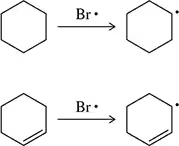
Which of the following reactions would you expect to be faster/more favorable in each pair? Why? (b)
Verified step by step guidance
1
Identify the type of reaction: Both reactions involve the abstraction of a hydrogen atom by a bromine radical (Br•) from a cyclohexane derivative, leading to the formation of a cyclohexyl radical.
Analyze the stability of the radicals formed: In the first reaction, the radical is formed on a saturated cyclohexane ring, while in the second reaction, the radical is formed on a cyclohexene ring, which has an alkene group.
Consider the effect of the alkene: The presence of the alkene in the cyclohexene can stabilize the radical through hyperconjugation and resonance, making the radical more stable compared to the radical formed in the saturated cyclohexane.
Evaluate the reaction rate: Reactions that form more stable intermediates (radicals, in this case) are generally faster and more favorable. Therefore, the reaction involving the cyclohexene is expected to be faster due to the additional stabilization of the radical.
Conclude which reaction is faster: Based on the stability of the radicals, the reaction involving the cyclohexene is more favorable and faster than the reaction involving the saturated cyclohexane.
Verified video answer for a similar problem:
This video solution was recommended by our tutors as helpful for the problem above
Play a video:
Was this helpful?
Key Concepts
Here are the essential concepts you must grasp in order to answer the question correctly.
Radical Stability
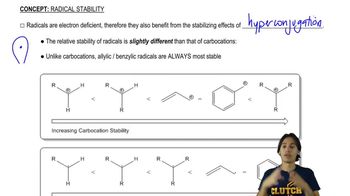
Radical stability is crucial in determining the rate of radical reactions. More stable radicals form faster and are more favorable. Stability is influenced by factors like hyperconjugation and resonance. In the image, the radical formed in the second reaction is stabilized by the adjacent double bond, making it more favorable.
Bromine radicals are highly reactive species that can abstract hydrogen atoms from organic molecules, forming new radicals. The reactivity of bromine radicals is influenced by the stability of the resulting radical. In the image, the bromine radical reacts with cyclohexane and cyclohexene, with the latter being more favorable due to radical stabilization.
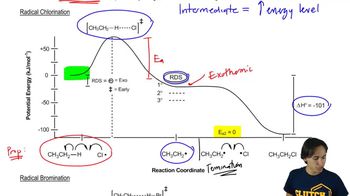
Using the Hammond Postulate to describe radical bromination.
Allylic Position
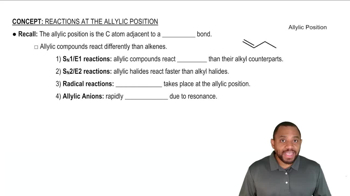
The allylic position refers to the carbon atom adjacent to a double bond. Radicals formed at allylic positions are more stable due to resonance stabilization, which allows the radical to be delocalized over the π system. In the image, the second reaction involves an allylic radical, making it faster and more favorable compared to the first reaction.