

Draw the mechanism for the elimination step in the Wohl degredation.
Verified step by step guidance
1
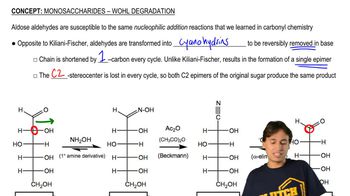
Understand the Wohl degradation: It is a reaction used to shorten an aldose sugar by one carbon atom. The elimination step involves the removal of hydrogen cyanide (HCN) from an intermediate imine compound.
Identify the intermediate: The intermediate in the Wohl degradation is an imine formed by the reaction of the aldose sugar with hydroxylamine (NH2OH) and subsequent dehydration. This imine is then treated with a base to initiate the elimination step.
Deprotonation step: A strong base (e.g., NaOH or KOH) deprotonates the hydrogen atom on the carbon adjacent to the imine group, forming a carbanion. This step is crucial for initiating the elimination process.
Formation of a double bond: The carbanion formed in the previous step donates its lone pair of electrons to form a double bond between the carbon and nitrogen atoms, leading to the elimination of the cyanide ion (CN⁻).
Final product: The elimination step results in the formation of an aldose sugar with one fewer carbon atom, along with the release of HCN as a byproduct. Ensure to draw the structure of the shortened aldose sugar and the eliminated HCN.
Verified video answer for a similar problem:
This video solution was recommended by our tutors as helpful for the problem above
Video duration:
3m
Play a video:
Was this helpful?
Key Concepts
Here are the essential concepts you must grasp in order to answer the question correctly.
Wohl Degradation
The Wohl degradation is a chemical reaction that involves the conversion of a sugar into a smaller sugar through a series of reactions, including oxidation and elimination. This process is particularly important in organic chemistry for understanding carbohydrate chemistry and the manipulation of sugar structures. The reaction typically starts with the formation of an intermediate that undergoes elimination to yield the final product.
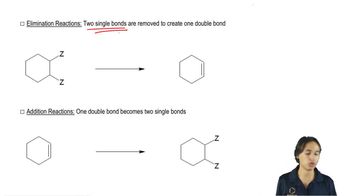
Elimination reactions are a class of organic reactions where two substituents are removed from a molecule, resulting in the formation of a double bond or a ring structure. In the context of the Wohl degradation, the elimination step involves the removal of a leaving group and a hydrogen atom, leading to the formation of a double bond. Understanding the mechanisms of elimination reactions, such as E1 and E2 pathways, is crucial for predicting the products of these reactions.
A reaction mechanism is a step-by-step description of the process by which reactants are converted into products in a chemical reaction. It outlines the sequence of elementary steps, including bond breaking and formation, and provides insight into the transition states and intermediates involved. For the Wohl degradation, drawing the mechanism requires knowledge of the specific steps involved in the elimination process, including the formation of intermediates and the final product.