What product or products are obtained when d-galactose reacts with each of the following? g. 1. hydroxylamine/trace acid 2. acetic anhydride/∆ 3. HO-/H2O
Verified step by step guidance
1
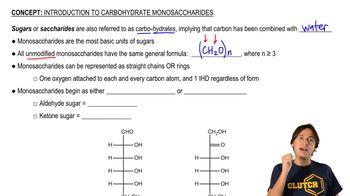
Step 1: Understand the structure of D-galactose. D-galactose is an aldohexose, meaning it contains six carbons and an aldehyde functional group at the first carbon. The remaining carbons have hydroxyl (-OH) groups in specific stereochemical configurations.
Step 2: Analyze the reaction with hydroxylamine (NH2OH) in the presence of trace acid. Hydroxylamine reacts with the aldehyde group of D-galactose to form an oxime. This reaction involves nucleophilic attack by the hydroxylamine on the carbonyl carbon of the aldehyde, followed by the elimination of water.
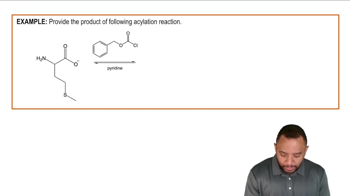
Step 3: Examine the reaction with acetic anhydride under heat (∆). Acetic anhydride reacts with the hydroxyl groups of D-galactose to form acetylated derivatives. Each hydroxyl group is converted into an acetate ester (-OCOCH3). This reaction is typically carried out under heating to ensure complete acetylation.
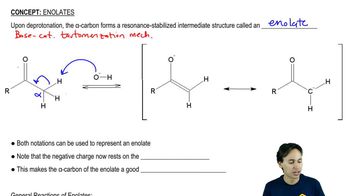
Step 4: Consider the reaction with hydroxide ion (HO-) in water (H2O). In the presence of a strong base like hydroxide, D-galactose can undergo isomerization or epimerization. The base can abstract a proton from the alpha-hydrogen of the aldehyde, leading to the formation of an enolate intermediate. This intermediate can tautomerize to form different isomers, such as D-mannose or D-fructose.
Step 5: Summarize the products. The reactions yield the following: (1) an oxime from the reaction with hydroxylamine, (2) a fully acetylated D-galactose derivative from the reaction with acetic anhydride, and (3) potential isomers (D-mannose or D-fructose) from the reaction with hydroxide in water.
Verified video answer for a similar problem:
This video solution was recommended by our tutors as helpful for the problem above
Video duration:
2m
Play a video:
Was this helpful?
Key Concepts
Here are the essential concepts you must grasp in order to answer the question correctly.
Monosaccharide Reactivity
Monosaccharides like d-galactose can undergo various chemical reactions due to their functional groups, primarily the aldehyde or ketone group. Understanding the reactivity of these groups is crucial for predicting the products formed during reactions with reagents such as hydroxylamine and acetic anhydride.
When d-galactose reacts with hydroxylamine in the presence of trace acid, it forms an oxime. This reaction involves the nucleophilic attack of hydroxylamine on the carbonyl carbon of the sugar, leading to the formation of a stable oxime product, which is a key step in carbohydrate chemistry.
Acetic anhydride reacts with d-galactose to perform acylation, where the hydroxyl groups of the sugar are converted into acetate esters. This reaction is significant for modifying the solubility and reactivity of sugars, and it can be used to protect hydroxyl groups in further synthetic applications.