Give the expected products of the following acid-catalyzed reactions. (d) cyclohexanone + piperidine
Verified step by step guidance
1
Step 1: Recognize the type of reaction. This is an acid-catalyzed reaction involving cyclohexanone (a ketone) and piperidine (a secondary amine). Such reactions typically lead to the formation of an imine or enamine.
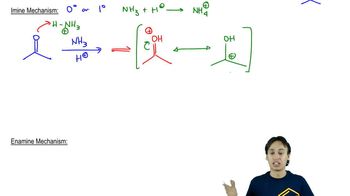
Step 2: Understand the mechanism. In the presence of an acid catalyst, the ketone group in cyclohexanone undergoes protonation at the oxygen atom, increasing its electrophilicity and making it more susceptible to nucleophilic attack by piperidine.
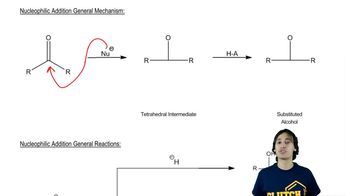
Step 3: Describe the nucleophilic attack. Piperidine, acting as a nucleophile, attacks the carbonyl carbon of cyclohexanone, forming a tetrahedral intermediate. This intermediate contains both the amine group from piperidine and the original oxygen from the ketone.
Step 4: Explain the dehydration step. Under acidic conditions, the intermediate loses a molecule of water (dehydration), leading to the formation of a double bond between the carbon and nitrogen atoms. This results in the formation of an imine (C=N bond).
Step 5: Consider the final product. Depending on the reaction conditions, the imine may tautomerize to form an enamine (C=C bond adjacent to a nitrogen atom). The final product is either an imine or enamine derived from cyclohexanone and piperidine.
Verified video answer for a similar problem:
This video solution was recommended by our tutors as helpful for the problem above
Video duration:
5m
Play a video:
Was this helpful?
Key Concepts
Here are the essential concepts you must grasp in order to answer the question correctly.
Acid-Catalyzed Reactions
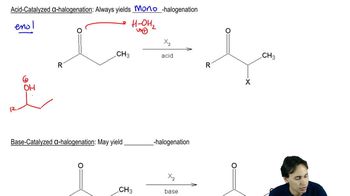
Acid-catalyzed reactions involve the use of an acid to increase the rate of a chemical reaction. In organic chemistry, acids can protonate reactants, making them more electrophilic and facilitating nucleophilic attacks. This is particularly important in reactions involving carbonyl compounds, where the carbonyl carbon becomes more reactive in the presence of an acid.
Nucleophilic addition to carbonyls is a fundamental reaction in organic chemistry where a nucleophile attacks the electrophilic carbon of a carbonyl group (C=O). In the case of cyclohexanone, the carbonyl carbon is susceptible to attack by nucleophiles like piperidine, leading to the formation of an intermediate that can further react to yield various products, including imines or amines.
Imines are formed when a carbonyl compound reacts with a primary amine or a secondary amine under acidic conditions. In this reaction, the amine acts as a nucleophile, attacking the carbonyl carbon, followed by dehydration to eliminate water and form a double bond between the nitrogen and carbon. This process is crucial in organic synthesis and can lead to various derivatives depending on the starting materials.