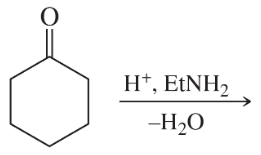
Predict the products of the following reactions: (g)
Verified step by step guidance
1
Step 1: Identify the functional group in the starting material. In this case, the starting material is a cyclic ketone (cyclohexanone). The carbonyl group (C=O) is reactive and will undergo nucleophilic attack.
Step 2: Recognize the reagents provided. The reaction involves ethylamine (EtNH₂) in the presence of an acid catalyst (H⁺). This suggests an imine formation reaction, where the amine reacts with the ketone to form an imine, with water (H₂O) as a byproduct.
Step 3: Understand the mechanism. The reaction proceeds as follows: (a) Protonation of the carbonyl oxygen by H⁺ increases the electrophilicity of the carbonyl carbon. (b) Ethylamine (EtNH₂) acts as a nucleophile and attacks the carbonyl carbon, forming a tetrahedral intermediate. (c) The intermediate undergoes dehydration (-H₂O) to form the imine product.
Step 4: Predict the structure of the product. The imine product will have the ethyl group (CH₃CH₂-) attached to the nitrogen atom, and the double bond will form between the nitrogen and the carbon that was originally part of the carbonyl group.
Step 5: Verify the reaction conditions. Ensure that the reaction is carried out under acidic conditions to facilitate protonation and dehydration, which are essential for imine formation.
Verified video answer for a similar problem:
This video solution was recommended by our tutors as helpful for the problem above
Video duration:
4m
Play a video:
Was this helpful?
Key Concepts
Here are the essential concepts you must grasp in order to answer the question correctly.
Electrophilic Addition
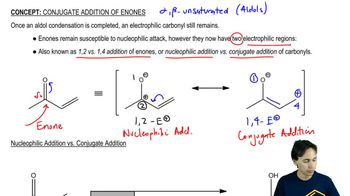
Electrophilic addition is a fundamental reaction mechanism in organic chemistry where an electrophile reacts with a nucleophile, leading to the formation of a more complex molecule. In this context, the carbonyl group (C=O) acts as an electrophile, attracting nucleophiles such as amines. Understanding this mechanism is crucial for predicting the products of reactions involving carbonyl compounds.
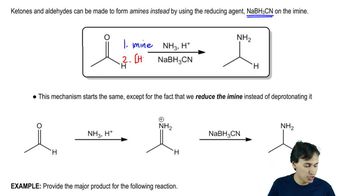
Amines are organic compounds derived from ammonia by replacing one or more hydrogen atoms with alkyl or aryl groups. In the given reaction, ethylamine (EtNH2) serves as a nucleophile that attacks the electrophilic carbon of the carbonyl group. Recognizing the role of amines in nucleophilic addition reactions is essential for predicting the resulting products, particularly in the formation of imines or enamines.
Dehydration reactions involve the removal of water (H2O) from a molecule, often leading to the formation of double bonds or new functional groups. In this case, after the nucleophilic attack by ethylamine on the carbonyl compound, the subsequent loss of water results in the formation of an imine. Understanding dehydration is key to predicting the final product of the reaction, especially in the context of carbonyl chemistry.