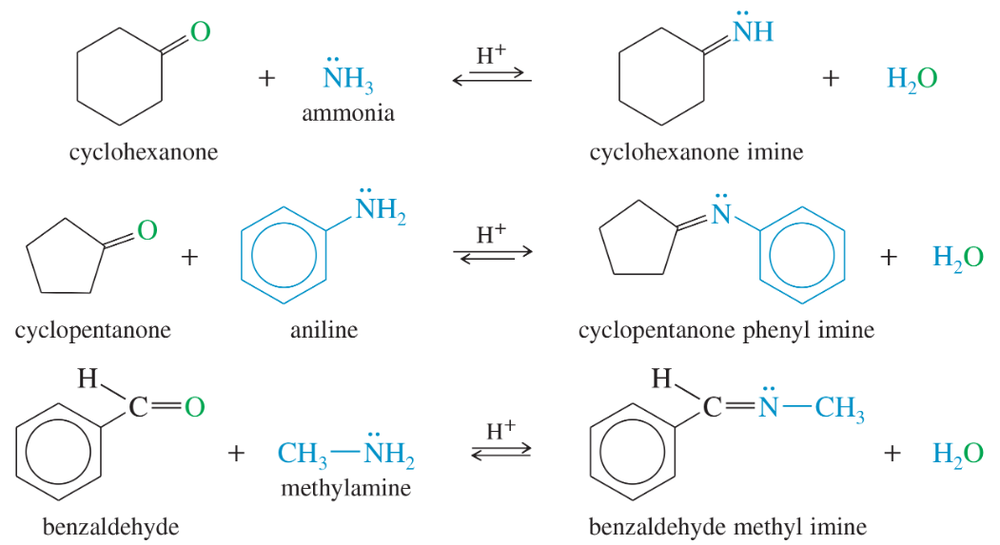
Propose mechanisms for the three imine-forming reactions just shown.
Verified step by step guidance
1
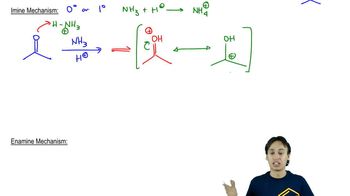
Step 1: Protonation of the carbonyl group - The reaction begins with the protonation of the oxygen atom in the carbonyl group (C=O) by the acid catalyst (H⁺). This increases the electrophilicity of the carbonyl carbon, making it more susceptible to nucleophilic attack.
Step 2: Nucleophilic attack by the amine - The amine (e.g., ammonia, aniline, or methylamine) attacks the carbonyl carbon, forming a tetrahedral intermediate. This step involves the lone pair of electrons on the nitrogen atom attacking the electrophilic carbon.
Step 3: Proton transfer - A proton transfer occurs within the intermediate to stabilize the structure. The hydroxyl group (-OH) formed in the intermediate is protonated, making it a better leaving group.
Step 4: Elimination of water - The protonated hydroxyl group leaves as water (H₂O), resulting in the formation of a double bond between the carbon and nitrogen atoms. This step forms the imine product.
Step 5: Deprotonation of the imine - The final step involves the deprotonation of the nitrogen atom in the imine to yield the neutral imine product. This completes the reaction mechanism.
Verified video answer for a similar problem:
This video solution was recommended by our tutors as helpful for the problem above
Video duration:
7m
Play a video:
Was this helpful?
Key Concepts
Here are the essential concepts you must grasp in order to answer the question correctly.
Imine Formation
Imine formation is a reaction between a carbonyl compound (like an aldehyde or ketone) and an amine, resulting in the creation of an imine. This process typically involves the nucleophilic attack of the amine on the carbonyl carbon, followed by the elimination of water. The reaction is often acid-catalyzed to enhance the electrophilicity of the carbonyl carbon.
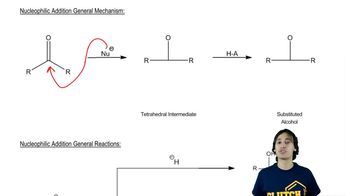
The mechanism of nucleophilic addition involves the attack of a nucleophile (the amine) on the electrophilic carbon of the carbonyl group. This step forms a tetrahedral intermediate, which then collapses to release a water molecule, leading to the formation of the imine. Understanding this mechanism is crucial for proposing the correct steps in the imine-forming reactions shown.
Acid-base catalysis plays a significant role in imine formation by protonating the carbonyl oxygen, making the carbonyl carbon more electrophilic. This increases the reactivity of the carbonyl compound towards nucleophiles. In the reactions depicted, the presence of an acid (H+) facilitates the formation of the imine by stabilizing the transition state and promoting the elimination of water.