Table 3-6 shows that the axial–equatorial energy difference for methyl, ethyl, and isopropyl groups increases gradually: 7.6, 7.9, and 8.8 kJ/mol (1.8, 1.9, and 2.1 kcal/mol). The tert-butyl group jumps to an energy difference of 23 kJ/mol (5.4 kcal/mol), over twice the value for the isopropyl group. Draw pictures of the axial conformations of isopropylcyclohexane and tert-butylcyclohexane, and explain why the tert-butyl substituent experiences such a large increase in axial energy over the isopropyl group.
Verified step by step guidance
1
To draw the axial conformation of isopropylcyclohexane, start by sketching a cyclohexane chair conformation. Place the isopropyl group on one of the axial positions, which are perpendicular to the plane of the ring.
For tert-butylcyclohexane, similarly draw a cyclohexane chair conformation and place the tert-butyl group in an axial position. The tert-butyl group is larger and bulkier than the isopropyl group.
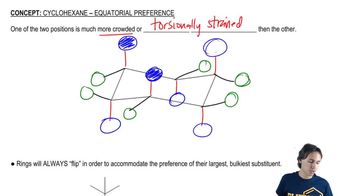
The axial position in a cyclohexane chair conformation is less stable for larger groups due to steric hindrance and 1,3-diaxial interactions. These interactions occur between the axial substituent and the hydrogen atoms on the same side of the ring.
The tert-butyl group experiences a larger increase in axial energy compared to the isopropyl group because it is bulkier, leading to greater steric hindrance and more significant 1,3-diaxial interactions.
The energy difference between axial and equatorial positions is much larger for tert-butyl groups because the equatorial position allows the bulky group to avoid steric clashes, making it significantly more stable than the axial position.
Verified video answer for a similar problem:
This video solution was recommended by our tutors as helpful for the problem above
Video duration:
2m
Play a video:
Was this helpful?
Key Concepts
Here are the essential concepts you must grasp in order to answer the question correctly.
Axial and Equatorial Positions
In cyclohexane, substituents can occupy two distinct positions: axial and equatorial. Axial substituents are oriented perpendicular to the plane of the ring, while equatorial substituents extend outward, parallel to the plane. The stability of these positions varies, with equatorial generally being more stable due to reduced steric hindrance and torsional strain.
Steric hindrance refers to the repulsion between atoms that occurs when they are brought close together, particularly in bulky groups. In the context of cyclohexane, larger substituents like tert-butyl experience significant steric hindrance when in the axial position, leading to increased energy and instability compared to smaller groups like isopropyl, which can fit more comfortably in the axial position.
The energy difference between axial and equatorial conformations is quantified in kJ/mol or kcal/mol. This difference arises from the steric interactions and torsional strain experienced by substituents in the axial position. For example, the tert-butyl group has a much larger energy difference due to its size, resulting in a more significant preference for the equatorial position compared to smaller groups like isopropyl.