Draw the two chair conformations of each of the following substituted cyclohexanes. In each case, label the more stable conformation. a. cis-1-ethyl-2-methylcyclohexane b. trans-1,2-diethylcyclohexane
Verified step by step guidance
1
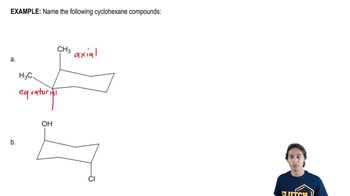
Identify the substituents and their positions on the cyclohexane ring for each compound. For cis-1-ethyl-2-methylcyclohexane, the ethyl and methyl groups are on adjacent carbons and on the same side of the ring. For trans-1,2-diethylcyclohexane, the ethyl groups are on adjacent carbons but on opposite sides of the ring.
Draw the basic cyclohexane chair conformation. Remember that cyclohexane can exist in two chair conformations that interconvert through a ring-flip.
For cis-1-ethyl-2-methylcyclohexane, place the ethyl group on carbon 1 and the methyl group on carbon 2. In the first chair conformation, place both substituents in axial positions. In the second chair conformation, perform a ring-flip to place both substituents in equatorial positions.
For trans-1,2-diethylcyclohexane, place one ethyl group on carbon 1 in an axial position and the other ethyl group on carbon 2 in an equatorial position in the first chair conformation. Perform a ring-flip to switch the positions of the ethyl groups, placing the first ethyl group in an equatorial position and the second in an axial position in the second chair conformation.
Evaluate the stability of each conformation by considering steric hindrance. Generally, the conformation with the larger substituents in equatorial positions is more stable due to reduced steric strain. Label the more stable conformation for each compound.
Verified video answer for a similar problem:
This video solution was recommended by our tutors as helpful for the problem above
Video duration:
9m
Play a video:
Was this helpful?
Key Concepts
Here are the essential concepts you must grasp in order to answer the question correctly.
Chair Conformation
Chair conformation is a three-dimensional shape that cyclohexane adopts to minimize steric strain and torsional strain. It resembles a chair, with alternating axial and equatorial positions for substituents. Understanding this conformation is crucial for analyzing the stability of substituted cyclohexanes.
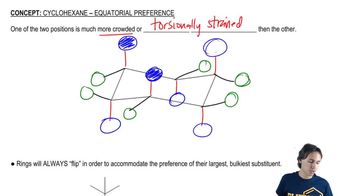
In cyclohexane's chair conformation, substituents can occupy axial positions, which are parallel to the ring's axis, or equatorial positions, which are around the equator of the ring. Equatorial positions are generally more stable due to reduced steric hindrance, making them preferable for larger substituents.
Cis and trans isomerism refers to the relative positioning of substituents on a cyclohexane ring. In cis isomers, substituents are on the same side, while in trans isomers, they are on opposite sides. This affects the stability and spatial arrangement of the chair conformations, influencing which conformation is more stable.