Predict the products formed when cyclohexanone reacts with the following reagents. (a) CH3NH2, H+
Verified step by step guidance
1
Step 1: Recognize the type of reaction. Cyclohexanone is a ketone, and the reagents CH3NH2 (methylamine) and H+ indicate an imine formation reaction, also known as a Schiff base formation. This reaction involves the nucleophilic addition of the amine to the carbonyl group of the ketone, followed by dehydration.
Step 2: Identify the nucleophile and electrophile. The carbonyl carbon in cyclohexanone is electrophilic due to the partial positive charge, while the nitrogen in CH3NH2 is nucleophilic due to its lone pair of electrons.
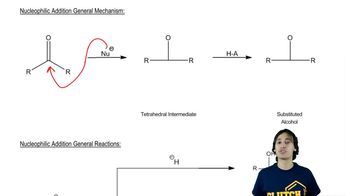
Step 3: Describe the mechanism. The reaction begins with the nucleophilic attack of the amine (CH3NH2) on the carbonyl carbon of cyclohexanone. This forms a tetrahedral intermediate where the oxygen of the carbonyl group becomes negatively charged.
Step 4: Protonation and dehydration. Under acidic conditions (H+), the intermediate undergoes protonation of the hydroxyl group, followed by the elimination of water (dehydration). This results in the formation of a double bond between the carbon and nitrogen, yielding an imine (Schiff base).
Step 5: Predict the product. The final product is an imine where the nitrogen is bonded to the cyclohexane ring via a double bond and also to a methyl group (CH3). The structure can be represented as: \( \text{C}_6\text{H}_{10}=N-\text{CH}_3 \).
Verified video answer for a similar problem:
This video solution was recommended by our tutors as helpful for the problem above
Video duration:
1m
Play a video:
0 Comments
Key Concepts
Here are the essential concepts you must grasp in order to answer the question correctly.
Nucleophilic Addition
Nucleophilic addition is a fundamental reaction mechanism in organic chemistry where a nucleophile attacks an electrophilic carbon atom, typically in a carbonyl group. In the case of cyclohexanone, the carbonyl carbon is susceptible to attack by nucleophiles like amines. This reaction leads to the formation of an intermediate that can further react to yield various products.
Amines are organic compounds derived from ammonia, where one or more hydrogen atoms are replaced by alkyl or aryl groups. In the presence of an acid (H+), amines can act as nucleophiles, forming stable adducts with carbonyl compounds. The reaction of cyclohexanone with methylamine (CH3NH2) in acidic conditions typically results in the formation of an imine or an enamine, depending on the reaction conditions.
Protonation of the carbonyl oxygen enhances the electrophilicity of the carbonyl carbon, making it more susceptible to nucleophilic attack. In acidic conditions, the carbonyl oxygen of cyclohexanone can be protonated, which stabilizes the carbonyl and facilitates the subsequent nucleophilic addition by the amine. This step is crucial for understanding the mechanism and predicting the products of the reaction.


 1:47 minutes
 Verified step by step guidance
 08:27
08:27