Nitrogen-containing heterocycles form particularly stable carbenes and are commonly used as ligands in organometallic chemistry. (a) Why is the carbene shown particularly stable? [It may be helpful to draw the molecular orbital picture.]
Verified step by step guidance
1
Examine the structure of the carbene provided in the image. The carbene is part of a nitrogen-containing heterocycle, specifically an imidazole ring. This structure is characterized by two nitrogen atoms and a conjugated π-system.
Understand the electronic stabilization of the carbene. The lone pair of electrons on the carbene carbon is stabilized by resonance with the adjacent nitrogen atoms. This delocalization of electrons reduces the electron density on the carbene carbon, making it less reactive and more stable.
Consider the role of the nitrogen atoms in the heterocycle. The nitrogen atoms are electron-rich and can donate electron density into the π-system of the ring. This further stabilizes the carbene through resonance and inductive effects.
Analyze the molecular orbital picture. The carbene carbon has an sp2 hybridization, with one empty p orbital and one lone pair of electrons. The lone pair can overlap with the π-system of the ring, forming a delocalized molecular orbital that contributes to the stability of the carbene.
Recognize the importance of aromaticity. The imidazole ring is aromatic, meaning it follows Huckel's rule (4n+2 π electrons). Aromaticity provides additional stabilization to the carbene, as the conjugated π-system is energetically favorable and resists disruption.
Verified video answer for a similar problem:
This video solution was recommended by our tutors as helpful for the problem above
Play a video:
Was this helpful?
Key Concepts
Here are the essential concepts you must grasp in order to answer the question correctly.
Carbenes
Carbenes are reactive intermediates containing a carbon atom with only six valence electrons, making them electron-deficient. They can exist in two forms: singlet, where the two non-bonding electrons are paired, and triplet, where they are unpaired. The stability of a carbene can be influenced by the surrounding atoms or groups, particularly through resonance or hyperconjugation, which can help stabilize the electron-deficient carbon.
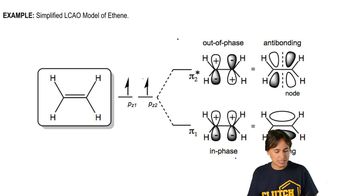
Molecular orbital (MO) theory describes the behavior of electrons in molecules by combining atomic orbitals to form molecular orbitals. These MOs can be bonding, non-bonding, or antibonding, and their occupancy determines the stability and reactivity of the molecule. A molecular orbital diagram can illustrate how the electrons are distributed in a molecule, providing insight into the stability of carbenes and their interactions with other species.
Ligands are ions or molecules that can donate a pair of electrons to a metal center, forming coordination complexes. In organometallic chemistry, nitrogen-containing heterocycles often act as bidentate or multidentate ligands, stabilizing metal centers through chelation. The stability of these complexes is crucial for catalysis and other chemical processes, as the nature of the ligand can significantly influence the reactivity and selectivity of the metal.