
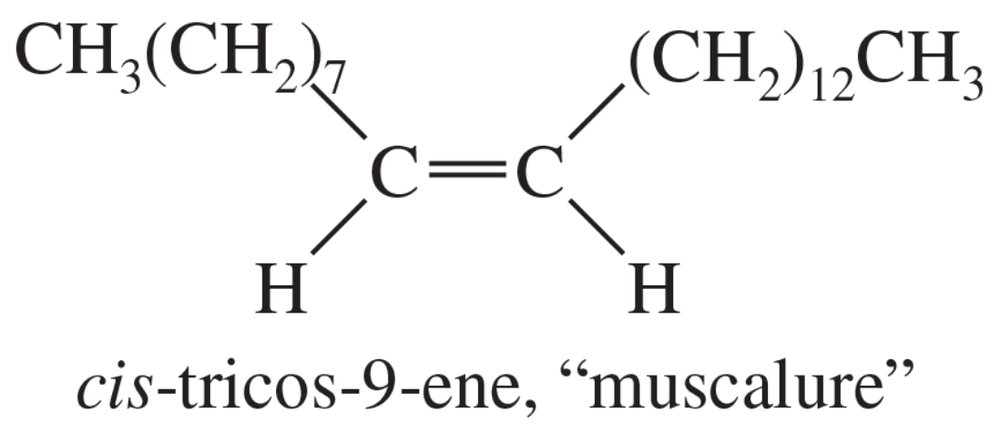
Muscalure, the sex attractant of the common housefly, is cis-tricos-9-ene. Most syntheses of alkenes give the more stable trans isomer as the major product. Devise a synthesis of muscalure from acetylene and other compounds of your choice. Your synthesis must give specifically the cis isomer of muscalure.
Verified step by step guidance
1
Step 1: Begin with acetylene (C≡CH) as the starting material. Acetylene can be used to build the carbon backbone of muscalure by successive alkylation reactions. First, convert acetylene into an acetylide ion (C≡C⁻) using a strong base such as sodium amide (NaNH₂). This ion is highly nucleophilic and can react with alkyl halides to form longer carbon chains.
Step 2: Perform two separate alkylation reactions to create the two alkyl chains that will be attached to the double bond. For the left chain (CH₃(CH₂)₇-), react the acetylide ion with an appropriate alkyl halide, such as 1-bromooctane (CH₃(CH₂)₇Br). For the right chain (CH₃(CH₂)₁₂-), react the acetylide ion with 1-bromotridecane (CH₃(CH₂)₁₂Br). These reactions will yield two terminal alkynes with the desired chain lengths.
Step 3: Couple the two alkynes to form a single molecule with a triple bond in the center. This can be achieved using a transition metal-catalyzed reaction, such as the Glaser coupling or a similar method. The result will be a molecule with the structure CH₃(CH₂)₇-C≡C-(CH₂)₁₂CH₃.
Step 4: Reduce the triple bond to a cis double bond. Use a selective hydrogenation method, such as Lindlar's catalyst, which stops the reduction at the alkene stage and specifically gives the cis isomer. This step is crucial to ensure the formation of cis-tricos-9-ene rather than the trans isomer.
Step 5: Verify the structure of the final product, cis-tricos-9-ene, using spectroscopic techniques such as NMR and IR. Ensure that the double bond is in the cis configuration and that the carbon chain lengths match the structure of muscalure.
Verified video answer for a similar problem:
This video solution was recommended by our tutors as helpful for the problem above
Video duration:
5m
Play a video:
Was this helpful?
Key Concepts
Here are the essential concepts you must grasp in order to answer the question correctly.
Alkene Isomerism
Alkenes can exist as geometric isomers due to the restricted rotation around the carbon-carbon double bond. The two main types of isomers are cis and trans, where 'cis' indicates that substituents are on the same side of the double bond, while 'trans' indicates they are on opposite sides. Understanding this concept is crucial for synthesizing specific isomers, such as cis-tricos-9-ene (muscalure), as the synthesis must favor the desired geometric configuration.
The synthesis of alkenes often involves reactions such as elimination reactions, where a precursor compound loses atoms or groups to form a double bond. Common methods include dehydrohalogenation of alkyl halides or dehydration of alcohols. In the context of muscalure synthesis, it is important to select starting materials and reaction conditions that will lead to the formation of the cis isomer rather than the more stable trans isomer.
The choice of reagents and reaction conditions significantly influences the outcome of organic reactions. For synthesizing specific isomers, using reagents that promote cis formation, such as certain catalysts or specific temperatures, is essential. Additionally, understanding the reactivity of acetylene and how it can be transformed into the desired alkene through controlled reactions is vital for successfully synthesizing muscalure.