Which of the following cyclic hemiacetals would you expect to have the highest Keq for their formation? Explain your answer. (a)
Verified step by step guidance
1
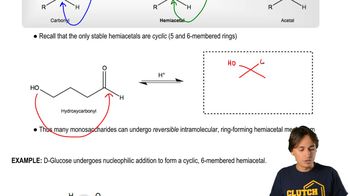
Identify the reactant and product in the given reaction. The reactant is a hydroxy aldehyde, and the product is a cyclic hemiacetal.
Understand that the formation of a cyclic hemiacetal involves the nucleophilic attack of the hydroxyl group on the carbonyl carbon, forming a new C-O bond and resulting in a ring structure.
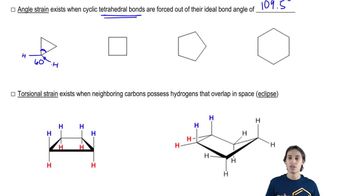
Consider the size of the ring formed in the cyclic hemiacetal. Smaller rings, such as three-membered rings, are generally less stable due to angle strain.
Evaluate the stability of the cyclic hemiacetal. Five- and six-membered rings are typically more stable due to minimal angle strain and favorable enthalpic and entropic factors.
Conclude that the equilibrium constant (Keq) for the formation of a cyclic hemiacetal is higher when the resulting ring is more stable, typically favoring five- or six-membered rings over smaller rings.
Verified video answer for a similar problem:
This video solution was recommended by our tutors as helpful for the problem above
Video duration:
4m
Play a video:
Was this helpful?
Key Concepts
Here are the essential concepts you must grasp in order to answer the question correctly.
Cyclic Hemiacetal Formation
Cyclic hemiacetals form when an alcohol group within a molecule reacts with an aldehyde or ketone group in the same molecule, creating a ring structure. This intramolecular reaction is favored when it results in a stable, five- or six-membered ring due to minimal ring strain and favorable enthalpic and entropic factors.
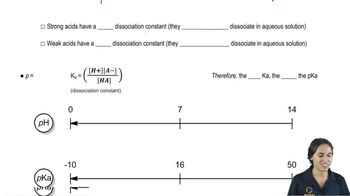
The equilibrium constant (K_eq) for a reaction quantifies the ratio of the concentration of products to reactants at equilibrium. A higher K_eq indicates that the products are favored at equilibrium, suggesting that the formation of the cyclic hemiacetal is more thermodynamically favorable compared to its open-chain form.
The relationship between equilibrium constant and pKa.
Ring Strain and Stability
Ring strain arises from bond angles deviating from their ideal values, torsional strain from eclipsing interactions, and steric strain from atoms being too close. Five- and six-membered rings are generally more stable due to minimal ring strain, making them more likely to form and persist, thus influencing the equilibrium position towards the cyclic form.