
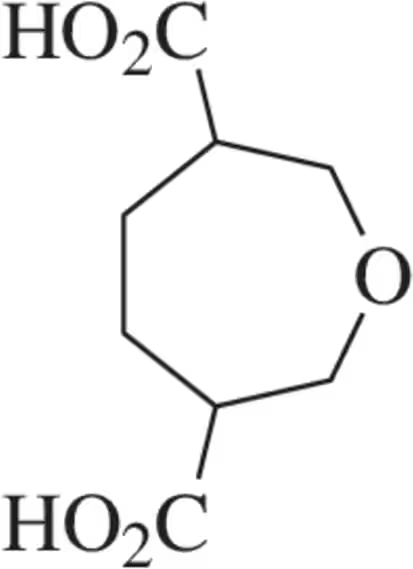
How many stereoisomers are possible for each of the following molecules? (b)
Verified step by step guidance
1
Step 1: Identify the chiral centers in the molecule. A chiral center is a carbon atom bonded to four different groups. In the given molecule, the two carbon atoms attached to the hydroxyl (-OH) groups are potential chiral centers.
Step 2: Determine the number of stereoisomers using the formula 2^n, where n is the number of chiral centers. Each chiral center can exist in two configurations (R or S), leading to multiple stereoisomers.
Step 3: Analyze the symmetry of the molecule. If the molecule has a plane of symmetry or other symmetry elements, some stereoisomers may be identical (meso compounds), reducing the total number of unique stereoisomers.
Step 4: Consider the ring structure. The cyclic nature of the molecule may impose conformational constraints, which could affect the stereoisomer count. Ensure that the spatial arrangement of substituents is consistent with the ring's geometry.
Step 5: Combine the information from steps 1-4 to calculate the total number of stereoisomers, accounting for any meso compounds or symmetry-related reductions.
Verified video answer for a similar problem:
This video solution was recommended by our tutors as helpful for the problem above
Video duration:
1m
Play a video:
Was this helpful?
Key Concepts
Here are the essential concepts you must grasp in order to answer the question correctly.
Stereoisomerism
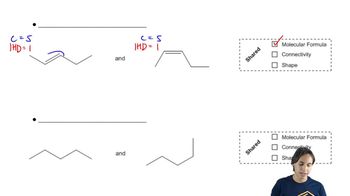
Stereoisomerism refers to the phenomenon where compounds have the same molecular formula and connectivity of atoms but differ in the spatial arrangement of their atoms. This can lead to different physical and chemical properties. The two main types of stereoisomers are enantiomers, which are non-superimposable mirror images, and diastereomers, which are not mirror images of each other.
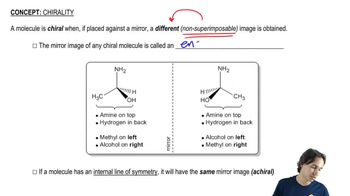
A chiral center, typically a carbon atom, is bonded to four different substituents, leading to non-superimposable mirror images. Molecules with one or more chiral centers can exist as enantiomers. In the context of the given molecule, identifying chiral centers is crucial for determining the number of possible stereoisomers.
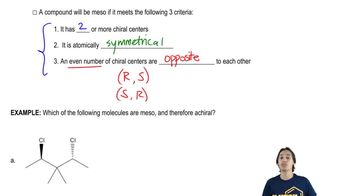
Meso compounds are a specific type of stereoisomer that contain multiple chiral centers but are achiral due to an internal plane of symmetry. This means that despite having chiral centers, the overall molecule does not exhibit optical activity. Recognizing whether a compound is meso is essential for accurately calculating the total number of stereoisomers.