
Textbook Question
Give common names for the following compounds.
(a) CH3–C≡C–CH2CH3
(b) Ph–C≡C–H
1221
views


 Verified step by step guidance
 03:43
03:43
 02:36
02:36 1:38
1:38Give common names for the following compounds.
(a) CH3–C≡C–CH2CH3
(b) Ph–C≡C–H
Using hex-1-ene as your starting material, show how you would synthesize the following compounds. (Once you have shown how to synthesize a compound, you may use it as the starting material in any later parts of this problem.)
d. hex-2-yne
e. hexan-2-one
f. hexanal
Give common names for the following compounds.
(c) 3-methyloct-4-yne
(d) (CH3)3C–C≡C–CH(CH3)CH2CH3
Using hex-1-ene as your starting material, show how you would synthesize the following compounds. (Once you have shown how to synthesize a compound, you may use it as the starting material in any later parts of this problem.)
g. pentanoic acid
h. pentanal
i. undec-6-yn-5-ol
Using hex-1-ene as your starting material, show how you would synthesize the following compounds. (Once you have shown how to synthesize a compound, you may use it as the starting material in any later parts of this problem.)
a. 1,2-dibromohexane
b. hex-1-yne
c. 2,2-dibromohexane
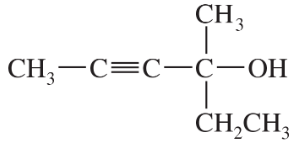
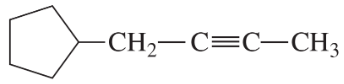
Give IUPAC names for the following compounds.
(a)
(b)
(c)