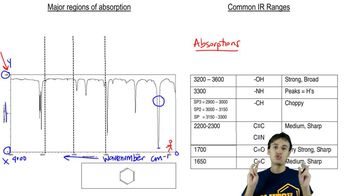
Hoping to make the following diene, a chemist treated the diol shown with acid. Based on the IR spectrum, was the reaction successful? If not, what compound was made instead? <IMAGE>
Verified step by step guidance
1
Identify the starting material: The problem mentions a diol, which is a compound containing two hydroxyl (OH) groups. Determine the structure of the diol based on the context provided in Chapter 13.
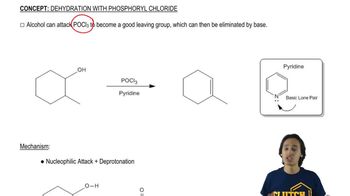
Understand the reaction conditions: The diol is treated with acid. This typically suggests a dehydration reaction, where water is removed to form a double bond, potentially leading to the formation of a diene.
Analyze the IR spectrum: Look for key absorptions. A successful conversion to a diene would show a decrease or absence of O-H stretching vibrations (around 3200-3600 cm-1) and the presence of C=C stretching vibrations (around 1600-1680 cm-1).
Determine the success of the reaction: If the IR spectrum shows the expected changes, the reaction likely produced the desired diene. If not, consider what other functional groups might be present, indicating a different product.
Consider alternative products: If the reaction was not successful, the presence of other peaks in the IR spectrum, such as C=O stretching (around 1700 cm-1), might suggest the formation of a different compound, such as a ketone or aldehyde, due to rearrangement or incomplete dehydration.
Verified video answer for a similar problem:
This video solution was recommended by our tutors as helpful for the problem above
Video duration:
1m
Play a video:
Was this helpful?
Key Concepts
Here are the essential concepts you must grasp in order to answer the question correctly.
Infrared (IR) Spectroscopy
IR spectroscopy is a technique used to identify functional groups in a molecule by measuring the absorption of infrared light, which causes molecular vibrations. Each type of bond and functional group absorbs at characteristic frequencies, allowing chemists to deduce structural information about the compound. In this context, analyzing the IR spectrum can help determine if the desired diene was formed by checking for the presence or absence of specific absorption bands.
A dehydration reaction involves the removal of water (H2O) from a molecule, often facilitated by an acid catalyst. In organic chemistry, this reaction is commonly used to convert alcohols into alkenes, such as dienes, by eliminating water. Understanding this mechanism is crucial for predicting the outcome of treating a diol with acid, as it helps determine whether the desired diene or another product was formed.
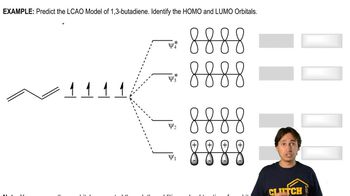
Dienes are hydrocarbons with two double bonds, and their formation often involves the elimination of water from diols. The success of this transformation depends on the reaction conditions and the stability of the resulting diene. Recognizing the structural features and stability factors that favor diene formation is essential for evaluating whether the reaction proceeded as intended or if an alternative product was generated.