Given the IR spectrum, suggest what functional groups might correspond to the given molecular formula. (d) C₇H₅O <IMAGE>
Verified step by step guidance
1
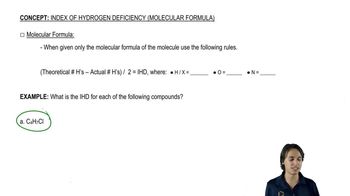
Start by analyzing the molecular formula C₇H₅O. Calculate the degree of unsaturation using the formula: \( ext{Degree of Unsaturation} = rac{2C + 2 + N - H - X}{2} \), where C is the number of carbons, N is the number of nitrogens, H is the number of hydrogens, and X is the number of halogens. For C₇H₅O, this calculation will help determine the number of rings and/or double bonds.
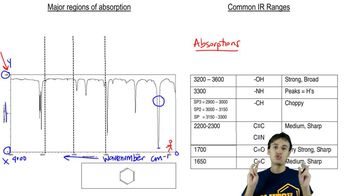
Examine the IR spectrum for key absorption bands. Look for a strong peak around 1700 cm⁻¹, which is indicative of a carbonyl group (C=O). This is a common functional group in organic molecules containing oxygen.
Identify any peaks in the region of 3000-3100 cm⁻¹, which could suggest the presence of aromatic C-H stretches. This is consistent with the presence of an aromatic ring, which is likely given the degree of unsaturation calculated earlier.
Check for any peaks around 1600 cm⁻¹ and 1500 cm⁻¹, which are characteristic of C=C stretches in aromatic rings. These peaks further support the presence of an aromatic ring in the structure.
Consider the possibility of other functional groups based on the IR spectrum. If there are no significant peaks in the region of 3200-3600 cm⁻¹, it is unlikely that there are hydroxyl groups (O-H) present. Use the combination of the IR data and the molecular formula to hypothesize the structure, likely involving an aromatic ring with a carbonyl group.
Verified video answer for a similar problem:
This video solution was recommended by our tutors as helpful for the problem above
Play a video:
Was this helpful?
Key Concepts
Here are the essential concepts you must grasp in order to answer the question correctly.
Infrared (IR) Spectroscopy
IR spectroscopy is a technique used to identify functional groups in a molecule by measuring the absorption of infrared light at different wavelengths. Each functional group has a characteristic absorption range, allowing for the identification of specific bonds and structures within a compound.
Functional groups are specific groups of atoms within molecules that are responsible for the characteristic chemical reactions of those molecules. Common functional groups include hydroxyl, carbonyl, and aromatic rings, each with distinct IR absorption patterns that help in identifying them in a spectrum.
Analyzing a molecular formula involves determining the possible structures and functional groups that fit the given formula. For C₇H₅O, one might consider aromatic compounds like benzaldehyde, which includes an aromatic ring and a carbonyl group, both detectable via IR spectroscopy.