
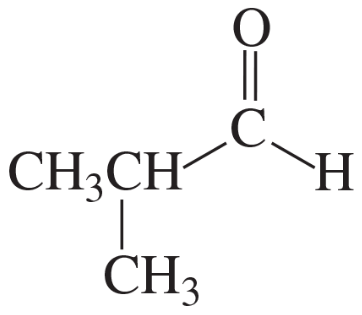
Describe the 1H NMR spectrum you would expect for each of the following compounds, indicating the relative positions of the signals: k.
Verified step by step guidance
1
Identify the structure of the compound in question. Determine the number of unique hydrogen environments (protons in different chemical environments) in the molecule. Each unique environment will correspond to a distinct signal in the 1H NMR spectrum.
Analyze the chemical environment of each set of equivalent protons. Consider factors such as proximity to electronegative atoms, double bonds, or aromatic rings, which can cause deshielding and shift the signal downfield (higher chemical shift).
Determine the splitting pattern for each signal based on the number of neighboring protons (n). Use the n+1 rule, where the number of peaks in a signal is equal to the number of equivalent neighboring protons plus one.
Estimate the relative integration of each signal. The integration corresponds to the number of protons contributing to each signal, which reflects the relative number of hydrogens in each environment.
Combine all the information to describe the expected 1H NMR spectrum, including the number of signals, their approximate chemical shifts, splitting patterns, and relative integrations. This will provide a complete picture of the spectrum for the compound.
Verified video answer for a similar problem:
This video solution was recommended by our tutors as helpful for the problem above
Video duration:
3m
Play a video:
Was this helpful?
Key Concepts
Here are the essential concepts you must grasp in order to answer the question correctly.
1H NMR Spectroscopy
1H NMR (Proton Nuclear Magnetic Resonance) spectroscopy is a powerful analytical technique used to determine the structure of organic compounds. It provides information about the number of hydrogen atoms in different environments within a molecule, allowing chemists to infer connectivity and functional groups. The resulting spectrum displays peaks corresponding to different hydrogen environments, with their positions (chemical shifts) indicating the electronic environment around the protons.
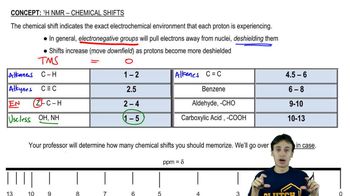
Chemical shift refers to the position of a signal in an NMR spectrum, measured in parts per million (ppm). It reflects the electronic environment surrounding the hydrogen atoms; for example, protons near electronegative atoms (like oxygen or nitrogen) appear downfield (higher ppm) due to deshielding. Understanding chemical shifts is crucial for interpreting the spectrum and identifying functional groups and molecular structure.
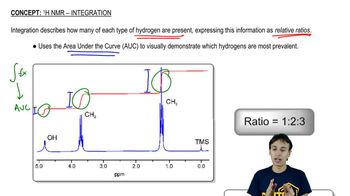
Integration in 1H NMR spectroscopy quantifies the area under each peak, which corresponds to the number of protons contributing to that signal. Multiplicity indicates the splitting pattern of the peaks, which arises from neighboring hydrogen atoms (n+1 rule). This information helps deduce the number of adjacent protons and provides insight into the molecular structure and connectivity of the compound.