Predict the products of the following reactions. (d) product of (c) + cyclopentylmagnesium bromide, then acidic hydrolysis
Verified step by step guidance
1
Step 1: Identify the functional groups in the starting material. The molecule contains a benzyl cyanide group (-CN), which is a nitrile functional group.
Step 2: Recognize the reagent used in the reaction. Cyclopentylmagnesium bromide is a Grignard reagent, which reacts with nitriles to form imines as intermediates.
Step 3: Predict the first step of the reaction. The Grignard reagent attacks the carbon of the nitrile group, forming an intermediate imine after the addition of the cyclopentyl group.
Step 4: Understand the role of acidic hydrolysis. The imine intermediate undergoes hydrolysis in the presence of H₃O⁺ to yield a ketone. The nitrogen is replaced by an oxygen atom, forming a cyclopentyl ketone attached to the benzyl group.
Step 5: Combine the steps to predict the final product. The reaction results in a benzyl ketone where the cyclopentyl group is attached to the carbonyl carbon.
Verified video answer for a similar problem:
This video solution was recommended by our tutors as helpful for the problem above
Video duration:
5m
Play a video:
Was this helpful?
Key Concepts
Here are the essential concepts you must grasp in order to answer the question correctly.
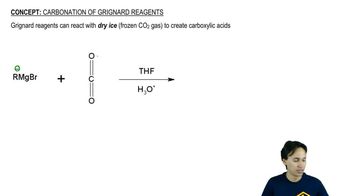
Grignard Reagents
Grignard reagents are organomagnesium compounds, typically represented as R-MgX, where R is an organic group and X is a halogen. They are highly reactive nucleophiles that can add to electrophiles, such as carbonyl compounds, to form new carbon-carbon bonds. In this reaction, cyclopentylmagnesium bromide acts as a Grignard reagent, attacking the electrophilic carbon of the substrate.
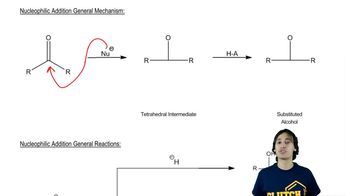
Nucleophilic addition is a fundamental reaction mechanism in organic chemistry where a nucleophile attacks an electrophilic center, typically a carbon atom in a carbonyl group. This process results in the formation of a new bond and often leads to the generation of alcohols or other functional groups upon subsequent reactions, such as hydrolysis. In this case, the Grignard reagent adds to the carbonyl carbon, forming an alkoxide intermediate.
Acidic hydrolysis is a reaction where an alkoxide intermediate is treated with an acid, typically H3O+, to yield an alcohol. This step is crucial for converting the alkoxide formed from the Grignard addition into a stable alcohol product. The acid protonates the alkoxide, resulting in the formation of the final alcohol product, which is essential for determining the outcome of the reaction sequence.