
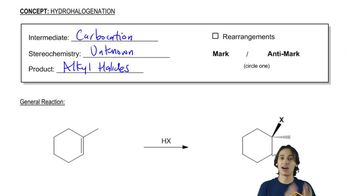
Propose mechanisms to explain the opposite regiochemistry observed in the following two reactions.
Verified step by step guidance
1
Step 1: Analyze the first reaction. The alkene reacts with HBr, and the regiochemistry observed is Markovnikov addition. This means the bromine atom adds to the more substituted carbon of the double bond. The ethyl group (-CH2CH3) is an electron-donating group, which stabilizes the carbocation formed on the more substituted carbon during the reaction.
Step 2: Propose the mechanism for the first reaction. The alkene undergoes protonation by HBr, forming a carbocation intermediate. The carbocation forms on the more substituted carbon due to its greater stability (Markovnikov rule). Bromide ion then attacks the carbocation, leading to the observed product.
Step 3: Analyze the second reaction. The alkene reacts with HBr, but the regiochemistry observed is anti-Markovnikov addition. This means the bromine atom adds to the less substituted carbon of the double bond. The thiomethyl group (-SCH3) is an electron-withdrawing group, which destabilizes the carbocation on the more substituted carbon and favors a different pathway.
Step 4: Propose the mechanism for the second reaction. The thiomethyl group (-SCH3) can interact with the alkene and HBr to promote a radical mechanism. In this pathway, the bromine atom adds to the less substituted carbon due to the stability of the radical intermediate formed on the less substituted carbon. This is characteristic of anti-Markovnikov addition.
Step 5: Compare the two mechanisms. The first reaction follows a carbocation pathway (Markovnikov addition) due to the electron-donating ethyl group, while the second reaction follows a radical pathway (anti-Markovnikov addition) due to the electron-withdrawing thiomethyl group. The opposite regiochemistry is explained by the differing electronic effects of the substituents on the alkene.
Verified video answer for a similar problem:
This video solution was recommended by our tutors as helpful for the problem above
Video duration:
2m
Play a video:
Was this helpful?
Key Concepts
Here are the essential concepts you must grasp in order to answer the question correctly.
Regiochemistry
Regiochemistry refers to the study of the distribution of products in a chemical reaction, particularly in terms of the position of substituents or functional groups in the resulting molecules. In reactions involving alkenes and electrophiles, such as the addition of HBr, the regioselectivity can lead to different products based on the stability of the carbocation intermediates formed during the reaction.
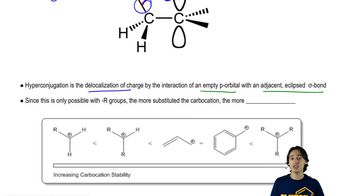
Carbocation stability is a crucial factor in determining the outcome of electrophilic addition reactions. More stable carbocations, such as tertiary carbocations, are favored over less stable ones, like primary carbocations. The stability is influenced by factors such as hyperconjugation and inductive effects from adjacent alkyl groups, which can direct the regioselectivity of the reaction.
Markovnikov's Rule states that in the addition of HX to an alkene, the hydrogen atom (H) will attach to the carbon with the greater number of hydrogen atoms already attached, while the halide (X) will attach to the carbon with fewer hydrogen atoms. This rule helps predict the major product in reactions involving alkenes and is essential for understanding the different regiochemistry observed in the provided reactions.