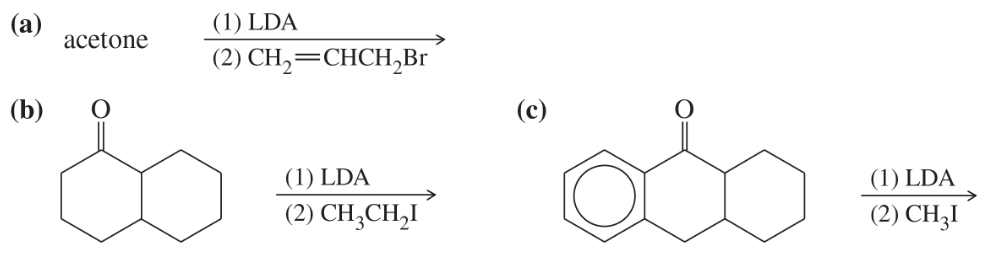
Predict the major products of the following reactions.
Verified step by step guidance
1
Step 1: Analyze the reaction conditions. LDA (Lithium Diisopropylamide) is a strong, non-nucleophilic base used to deprotonate the most acidic hydrogen in the molecule, typically forming an enolate intermediate. CH3I or CH3CH2I are alkylating agents that react with the enolate to form a new C-C bond.
Step 2: For reaction (a), identify the most acidic hydrogen in the molecule. The ketone group has alpha hydrogens (hydrogens attached to the carbon adjacent to the carbonyl group). LDA will deprotonate one of these alpha hydrogens to form an enolate ion.
Step 3: The enolate formed in reaction (a) will then react with CH3I via an SN2 mechanism. The methyl group from CH3I will attach to the alpha carbon of the enolate, forming a new C-C bond.
Step 4: For reaction (b), the same process occurs. LDA deprotonates an alpha hydrogen of the cyclohexanone to form an enolate. The enolate reacts with CH3I, resulting in the methylation of the alpha carbon.
Step 5: For reaction (c), LDA deprotonates the alpha hydrogen adjacent to the carbonyl group in the bicyclic compound. The enolate formed reacts with CH3CH2I, leading to ethylation at the alpha carbon. Consider steric effects and regioselectivity in the product formation.
Verified video answer for a similar problem:
This video solution was recommended by our tutors as helpful for the problem above
Video duration:
2m
Play a video:
Was this helpful?
Key Concepts
Here are the essential concepts you must grasp in order to answer the question correctly.
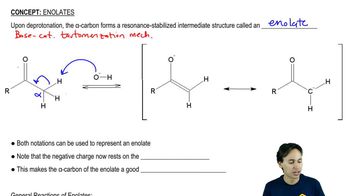
Enolate Formation
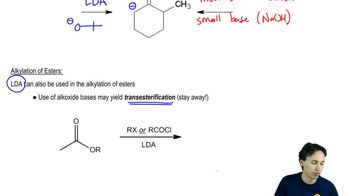
Enolates are formed from carbonyl compounds (like ketones and aldehydes) through deprotonation at the alpha carbon. This reaction is typically facilitated by strong bases such as LDA (Lithium diisopropylamide). The resulting enolate ion is a nucleophile that can react with electrophiles, making it crucial for predicting reaction products in alkylation and acylation processes.
Alkylation involves the reaction of an enolate ion with an alkyl halide, leading to the formation of a new carbon-carbon bond. The choice of alkyl halide affects the regioselectivity and stereochemistry of the product. In the context of the reactions shown, understanding how enolates react with methyl iodide (CH3I) is essential for predicting the major products.
Acylation is the process where an enolate reacts with an acyl chloride or an anhydride, resulting in the formation of a beta-keto ester or a beta-diketone. This reaction is significant in synthetic organic chemistry for constructing complex molecules. Recognizing the role of the enolate as a nucleophile in acylation helps in predicting the products of the reactions depicted in the question.