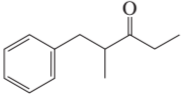
How could each of the following compounds be prepared from a ketone and an alkyl halide? b.
Verified step by step guidance
1
Step 1: Identify the target compound structure. The compound shown is a β-aryl ketone, which can be synthesized using a ketone and an alkyl halide through the alkylation of enolates.
Step 2: Select the ketone precursor. The ketone precursor should be cyclopentanone, as it provides the cyclic ketone structure in the target molecule.
Step 3: Select the alkyl halide. The alkyl halide should be benzyl bromide (C6H5CH2Br), as it introduces the benzyl group to the ketone.
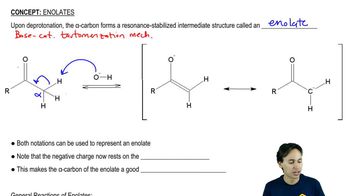
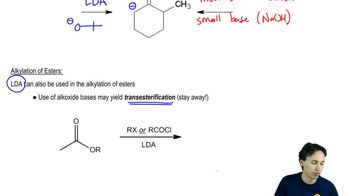
Step 4: Generate the enolate. Treat cyclopentanone with a strong base, such as LDA (Lithium Diisopropylamide), to form the enolate ion. This step is crucial for nucleophilic attack on the alkyl halide.
Step 5: Perform the alkylation reaction. React the enolate ion with benzyl bromide in an SN2 reaction mechanism to form the β-aryl ketone shown in the target structure.
Verified video answer for a similar problem:
This video solution was recommended by our tutors as helpful for the problem above
Video duration:
2m
Play a video:
Was this helpful?
Key Concepts
Here are the essential concepts you must grasp in order to answer the question correctly.
Enolate Formation
Enolates are formed from ketones through deprotonation at the alpha carbon, resulting in a resonance-stabilized anion. This process is typically facilitated by a strong base, which abstracts a proton, allowing the carbonyl compound to become nucleophilic. Enolates are crucial intermediates in various organic reactions, including alkylation and acylation.
Alkylation involves the reaction of an enolate ion with an alkyl halide, where the nucleophilic enolate attacks the electrophilic carbon of the halide. This reaction results in the formation of a new carbon-carbon bond, extending the carbon chain. The choice of alkyl halide can influence the regioselectivity and stereochemistry of the product formed.
Acylation of enolates involves the reaction of an enolate with an acyl halide or an acid anhydride, leading to the formation of a β-keto ester or a β-diketone. This process allows for the introduction of acyl groups into the molecule, which can further participate in various synthetic transformations. Acylation is a key step in the synthesis of complex organic molecules.