Draw the products of the following reactions: c. acetone + LDA/THF: (1) slow addition of ethyl acetate; (2) HCl
Verified step by step guidance
1
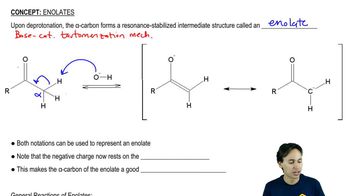
Step 1: Identify the role of LDA (Lithium Diisopropylamide) in the reaction. LDA is a strong, non-nucleophilic base that is used to deprotonate the alpha-hydrogen of acetone, forming an enolate ion. This enolate is highly nucleophilic and will participate in subsequent reactions.
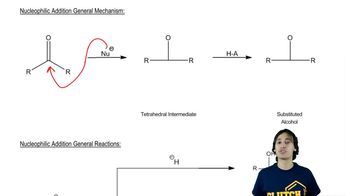
Step 2: Recognize the slow addition of ethyl acetate. Ethyl acetate is an ester, and its carbonyl group is electrophilic. The enolate ion formed from acetone will attack the carbonyl carbon of ethyl acetate in a nucleophilic addition reaction, forming a new carbon-carbon bond.
Step 3: Understand the intermediate formed after the nucleophilic attack. The product of this step will be a beta-keto ester, where the acetone enolate has added to the ethyl acetate molecule. This intermediate will have both a ketone and an ester functional group.
Step 4: Analyze the role of HCl in the second step. HCl is an acid that will protonate the intermediate, stabilizing it and completing the reaction. This step ensures the final product is neutral and fully formed.
Step 5: Draw the final product. The final product will be a beta-keto ester, specifically ethyl 3-oxobutanoate, formed by the addition of acetone enolate to ethyl acetate followed by protonation with HCl.
Verified video answer for a similar problem:
This video solution was recommended by our tutors as helpful for the problem above
Video duration:
2m
Play a video:
Was this helpful?
Key Concepts
Here are the essential concepts you must grasp in order to answer the question correctly.
Enolate Formation
Enolate formation is a key step in reactions involving carbonyl compounds, where a base abstracts a proton from the alpha carbon, resulting in a resonance-stabilized enolate ion. In this reaction, LDA (Lithium diisopropylamide) acts as a strong base to deprotonate acetone, generating the enolate that can subsequently react with electrophiles like ethyl acetate.
Nucleophilic addition is a fundamental reaction mechanism in organic chemistry where a nucleophile attacks an electrophilic carbon atom, typically in carbonyl compounds. In this case, the enolate formed from acetone acts as a nucleophile and attacks the carbonyl carbon of ethyl acetate, leading to the formation of a beta-hydroxy carbonyl compound.
An acid workup is a common procedure in organic synthesis that involves adding an acid, such as HCl, to neutralize the reaction mixture and protonate any basic species. After the nucleophilic addition of the enolate to ethyl acetate, the addition of HCl helps to stabilize the product and convert any remaining enolate or intermediate into the final carbonyl product, facilitating purification.