Why isn’t FeBr3 used as a catalyst in the first step of the synthesis of 1,3,5-tribromobenzene?
Verified step by step guidance
1
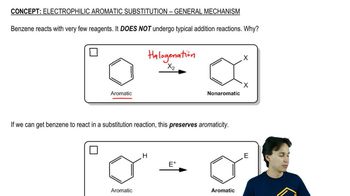
Understand the role of FeBr₃ in electrophilic aromatic substitution (EAS): FeBr₃ is a Lewis acid catalyst that activates Br₂ by polarizing the Br-Br bond, making one bromine atom more electrophilic and reactive toward the aromatic ring.
Recognize the reactivity of benzene: Benzene is relatively stable due to its aromaticity, and FeBr₃ is typically used to facilitate the bromination of benzene by generating a stronger electrophile (Br⁺).
Consider the product, 1,3,5-tribromobenzene: This compound has three bromine substituents in a symmetrical arrangement. Bromine atoms are electron-withdrawing and deactivating, making the benzene ring less reactive after each bromination step.
Analyze the first bromination step: In the synthesis of 1,3,5-tribromobenzene, the first bromination does not require FeBr₃ because benzene is sufficiently reactive to undergo bromination with Br₂ alone. Using FeBr₃ in the first step could lead to over-bromination or undesired side reactions.
Conclude why FeBr₃ is not used initially: FeBr₃ is unnecessary in the first step because benzene's reactivity is adequate for bromination with Br₂. The catalyst is more useful in subsequent steps when the ring becomes less reactive due to the electron-withdrawing effects of the bromine substituents.
Verified video answer for a similar problem:
This video solution was recommended by our tutors as helpful for the problem above
Video duration:
1m
Play a video:
Was this helpful?
Key Concepts
Here are the essential concepts you must grasp in order to answer the question correctly.
Electrophilic Aromatic Substitution (EAS)
Electrophilic Aromatic Substitution is a fundamental reaction in organic chemistry where an electrophile replaces a hydrogen atom on an aromatic ring. This process is crucial for synthesizing substituted aromatic compounds, such as 1,3,5-tribromobenzene. Understanding the mechanism of EAS helps in predicting the reactivity and orientation of substituents on the aromatic ring.
Catalysts are substances that increase the rate of a chemical reaction without being consumed in the process. In organic reactions, catalysts can help stabilize transition states or lower activation energy. The choice of catalyst is critical, as it must facilitate the desired reaction while avoiding side reactions or deactivation, which is relevant in the context of using FeBr3.
Iron(III) bromide (FeBr3) is often used as a Lewis acid catalyst in electrophilic aromatic substitution reactions. However, its reactivity can be influenced by the nature of the electrophile and the substrate. In the case of synthesizing 1,3,5-tribromobenzene, FeBr3 may not be suitable due to potential side reactions or insufficient activation of the bromine electrophile, leading to poor yields.