Bromination of phenol or aniline does not require the use of a Lewis acid catalyst and often results in trihalogenation. Why?
Verified step by step guidance
1
Identify the functional groups present in phenol and aniline. Phenol has a hydroxyl group (-OH) attached to the benzene ring, and aniline has an amino group (-NH2) attached to the benzene ring.
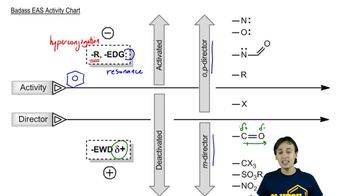
Understand the activating effects of these functional groups. Both the hydroxyl group in phenol and the amino group in aniline are strong electron-donating groups. They increase the electron density on the benzene ring through resonance, making the ring more reactive towards electrophilic aromatic substitution.
Recognize the role of electron-donating groups in directing substitution. The -OH and -NH2 groups are ortho/para-directing, meaning they increase the likelihood of substitution occurring at the ortho and para positions relative to the functional group.
Explain why a Lewis acid catalyst is not required. The increased electron density on the benzene ring due to the electron-donating groups makes the ring sufficiently reactive to undergo bromination without the need for a Lewis acid catalyst, which is typically used to activate the bromine.
Discuss why trihalogenation occurs. The high reactivity of the benzene ring in phenol and aniline, due to the strong activating effects of the -OH and -NH2 groups, often leads to multiple brominations, resulting in trihalogenation at the ortho and para positions.
Verified video answer for a similar problem:
This video solution was recommended by our tutors as helpful for the problem above
Play a video:
Was this helpful?
Key Concepts
Here are the essential concepts you must grasp in order to answer the question correctly.
Electrophilic Aromatic Substitution
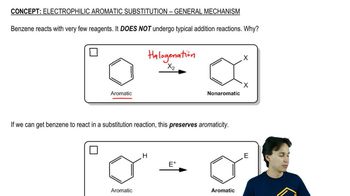
Electrophilic aromatic substitution (EAS) is a fundamental reaction in organic chemistry where an electrophile replaces a hydrogen atom on an aromatic ring. In the case of phenol and aniline, the hydroxyl (-OH) and amino (-NH2) groups are strong activating groups that enhance the reactivity of the aromatic ring, allowing for multiple substitutions without the need for a Lewis acid catalyst.
Activating groups are substituents on an aromatic ring that increase the rate of electrophilic substitution reactions. Hydroxyl and amino groups are examples of activating groups that donate electron density to the ring, making it more nucleophilic. This increased reactivity facilitates the bromination process, often leading to trihalogenation due to the enhanced electrophilic attack on the ring.
Trihalogenation refers to the substitution of three halogen atoms in a compound. In the context of phenol and aniline, the presence of strong activating groups allows for multiple bromine atoms to be introduced onto the aromatic ring. This occurs because the electron-rich nature of the ring can stabilize the positive charge that develops during the electrophilic substitution, enabling further substitutions to occur.