What is the major product(s) of each of the following reactions? b. chlorination of o-benzenedicarboxylic acid
Verified step by step guidance
1
Identify the structure of o-benzenedicarboxylic acid. It is a benzene ring with two carboxylic acid groups (-COOH) in the ortho position (adjacent to each other).
Understand the reactivity of the molecule. The carboxylic acid groups are electron-withdrawing due to their resonance and inductive effects, which deactivate the benzene ring toward electrophilic aromatic substitution (EAS) reactions like chlorination.
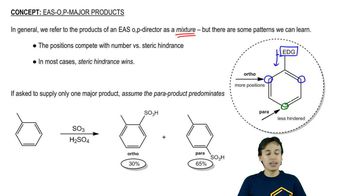
Determine the directing effects of the substituents. The carboxylic acid groups are meta-directing because they withdraw electron density from the benzene ring, making the meta positions (relative to each -COOH group) more favorable for substitution.
Consider the reaction conditions. Chlorination typically involves Cl₂ and a Lewis acid catalyst like FeCl₃, which generates the electrophile (Cl⁺) for the EAS reaction.
Predict the major product. The chlorine atom will substitute at the position meta to one of the carboxylic acid groups, as this is the most favorable position based on the electronic effects of the substituents.
Verified video answer for a similar problem:
This video solution was recommended by our tutors as helpful for the problem above
Video duration:
2m
Play a video:
Was this helpful?
Key Concepts
Here are the essential concepts you must grasp in order to answer the question correctly.
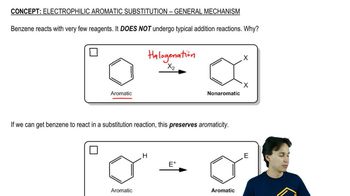
Electrophilic Aromatic Substitution
Electrophilic aromatic substitution (EAS) is a fundamental reaction in organic chemistry where an electrophile replaces a hydrogen atom on an aromatic ring. This process is crucial for understanding how substituents on the ring influence the reactivity and orientation of further substitutions. In the case of chlorination, chlorine acts as the electrophile, and the presence of carboxylic acid groups can direct the substitution to specific positions on the benzene ring.
Substituents on an aromatic ring can influence the position where new substituents are added. Electron-donating groups, such as -COOH in o-benzenedicarboxylic acid, are ortho/para directors, meaning they favor substitution at the ortho or para positions relative to themselves. This concept is essential for predicting the major products of reactions involving substituted aromatic compounds, as it helps determine the most likely sites for electrophilic attack.
Regioselectivity refers to the preference of a chemical reaction to occur at one location over another in a molecule. In the chlorination of o-benzenedicarboxylic acid, the regioselectivity is influenced by the directing effects of the carboxylic acid groups, which can lead to the formation of specific isomers. Understanding regioselectivity is vital for predicting the major products of reactions involving complex organic molecules.