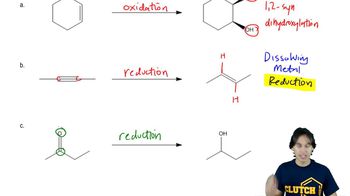
Identify each of the following reactions as an oxidation reaction, a reduction reaction, or neither. a. b.
Verified step by step guidance
1
Step 1: Analyze the first reaction. The starting material is CH₃CH=CHCH₃ (an alkene) reacting with Cl₂ in CH₂Cl₂ solvent. The product is CH₃CHClCHClCH₃, where the double bond is replaced by two chlorine atoms. This is an addition reaction where the π-bond of the alkene is broken, and two new σ-bonds are formed with chlorine atoms. Since there is no change in the oxidation state of the carbon atoms, this reaction is classified as 'neither oxidation nor reduction.'
Step 2: Analyze the second reaction. The starting material is CH₃CH=CHCH₃ (an alkene) reacting with H₂O in the presence of H₂SO₄. The product is CH₃CH(OH)CH₂CH₃, where the double bond is replaced by a hydroxyl group (-OH) and a hydrogen atom. This is an addition reaction where the π-bond of the alkene is broken, and new σ-bonds are formed. Since there is no change in the oxidation state of the carbon atoms, this reaction is also classified as 'neither oxidation nor reduction.'
Step 3: Understand the concept of oxidation and reduction in organic chemistry. Oxidation typically involves an increase in the number of bonds to oxygen or other electronegative atoms, or a decrease in the number of bonds to hydrogen. Reduction involves the opposite: an increase in the number of bonds to hydrogen or a decrease in the number of bonds to electronegative atoms.
Step 4: Recognize that addition reactions to alkenes, such as halogenation or hydration, often do not involve changes in oxidation states unless the added groups significantly alter the electron density around the carbon atoms.
Step 5: Conclude that both reactions provided are addition reactions and are classified as 'neither oxidation nor reduction' based on the analysis of oxidation states and the nature of the chemical changes.
Verified video answer for a similar problem:
This video solution was recommended by our tutors as helpful for the problem above
Video duration:
2m
Play a video:
Was this helpful?
Key Concepts
Here are the essential concepts you must grasp in order to answer the question correctly.
Oxidation and Reduction
Oxidation and reduction are chemical processes that involve the transfer of electrons between substances. Oxidation refers to the loss of electrons or an increase in oxidation state, while reduction involves the gain of electrons or a decrease in oxidation state. These reactions are often coupled, meaning that when one substance is oxidized, another is reduced.
Oxidation states (or oxidation numbers) are a way to keep track of electron transfer in chemical reactions. Each element in a compound is assigned an oxidation state based on its electron configuration and bonding. Understanding how to assign oxidation states is crucial for identifying whether a reaction is an oxidation or reduction.
To classify a reaction as oxidation, reduction, or neither, one must analyze the changes in oxidation states of the reactants and products. If the oxidation state of an element increases, it is oxidized; if it decreases, it is reduced. If there is no change in oxidation states, the reaction is classified as neither.