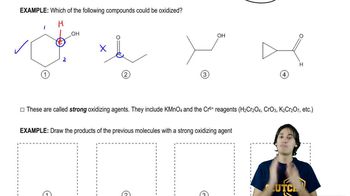
Which of the reactions studied in this chapter result in oxidation of the organic molecule? Justify your answer. (b)
Verified step by step guidance
1
Identify the type of reaction: The reaction shown is an addition reaction where HBr is added across the double bond of an alkene.
Determine the change in oxidation state: In organic chemistry, oxidation is typically associated with an increase in the number of bonds to oxygen or a decrease in the number of bonds to hydrogen. Here, the alkene is converted to an alkyl bromide.
Analyze the oxidation state of carbon: In the alkene, each carbon of the double bond is bonded to two hydrogens and one carbon. In the product, one of these carbons is now bonded to a bromine atom instead of a hydrogen.
Evaluate the effect of bromine: Bromine is more electronegative than hydrogen, but the addition of bromine does not increase the oxidation state of carbon in the same way that adding oxygen would. Therefore, this reaction does not result in oxidation.
Conclude the analysis: Since the reaction involves the addition of HBr without an increase in the oxidation state of carbon, it is not considered an oxidation reaction.
Verified video answer for a similar problem:
This video solution was recommended by our tutors as helpful for the problem above
Play a video:
Was this helpful?
Key Concepts
Here are the essential concepts you must grasp in order to answer the question correctly.
Oxidation in Organic Chemistry
Oxidation refers to the process where an organic molecule loses electrons, often accompanied by an increase in oxidation state. In organic reactions, this can involve the addition of oxygen or the removal of hydrogen. Understanding the specific changes in oxidation states helps identify which reactions qualify as oxidation.
Oxidizing agents are substances that facilitate the oxidation of organic molecules by accepting electrons. Common examples include potassium permanganate (KMnO4), chromium trioxide (CrO3), and oxygen itself. Recognizing these agents is crucial for determining which reactions lead to oxidation.
The mechanism of a reaction describes the step-by-step process by which reactants are converted into products. Understanding the mechanisms of oxidation reactions, including electron transfer and bond breaking/forming, is essential for justifying which reactions result in oxidation of the organic molecule.