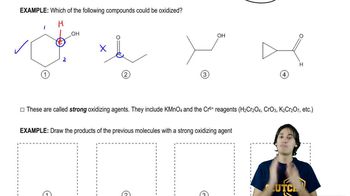
Calculate the oxidation number for the indicated carbons. (d)
Verified step by step guidance
1
Identify the carbon atom whose oxidation number needs to be calculated. In the image, the indicated carbon is the one bonded to the oxygen atom and two other carbon atoms.
Understand that the oxidation number is a measure of the degree of oxidation of an atom in a molecule. It is calculated based on the electronegativity of the atoms bonded to the carbon.
Assign oxidation numbers based on electronegativity: Oxygen is more electronegative than carbon, so it will take the electrons in the C-O bond, giving the carbon a +1 oxidation state for each bond with oxygen.
Consider the C-C bonds: Since the two carbon atoms bonded to the indicated carbon have similar electronegativity, these bonds do not contribute to the oxidation number.
Sum the contributions: The indicated carbon has one bond with oxygen contributing +1 to its oxidation number. Therefore, the oxidation number of the indicated carbon is +1.
Verified video answer for a similar problem:
This video solution was recommended by our tutors as helpful for the problem above
Play a video:
Was this helpful?
Key Concepts
Here are the essential concepts you must grasp in order to answer the question correctly.
Oxidation Number
The oxidation number is a theoretical charge assigned to an atom in a molecule, reflecting its degree of oxidation or reduction. It helps in understanding electron transfer in redox reactions. The oxidation number can be determined using a set of rules, such as the fact that the oxidation number of an element in its elemental form is zero, and the sum of oxidation numbers in a neutral compound must equal zero.
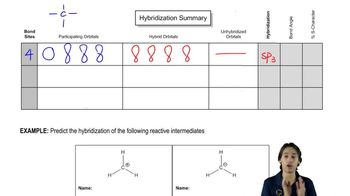
Carbon hybridization describes the mixing of atomic orbitals to form new hybrid orbitals, which influences the geometry and bonding of carbon-containing compounds. Common hybridizations include sp, sp2, and sp3, corresponding to different bonding scenarios. Understanding hybridization is crucial for determining the molecular structure and the oxidation states of carbon atoms in various compounds.
Functional groups are specific groups of atoms within molecules that are responsible for the characteristic chemical reactions of those molecules. They dictate the reactivity and properties of organic compounds. Recognizing functional groups is essential for calculating oxidation numbers, as they often influence the electron distribution and oxidation states of the carbon atoms involved.