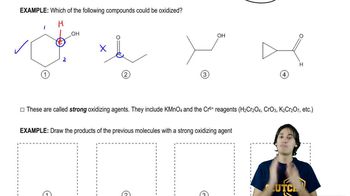
Which of the reactions studied in this chapter result in oxidation of the organic molecule? Justify your answer. (c)
Verified step by step guidance
1
Identify the reaction type: The image shows a reaction involving N-bromosuccinimide (NBS) and heat, which is typically used for allylic bromination.
Understand allylic bromination: This reaction involves the substitution of a hydrogen atom at the allylic position (next to a double bond) with a bromine atom.
Analyze oxidation: In organic chemistry, oxidation often involves the increase in the number of bonds to oxygen or other electronegative atoms, or the loss of hydrogen atoms.
Evaluate the change in oxidation state: In the given reaction, a hydrogen atom is replaced by a bromine atom. Bromine is more electronegative than hydrogen, which can be considered as an increase in oxidation state.
Conclude the oxidation process: Since the reaction involves the replacement of a hydrogen atom with a more electronegative bromine atom, it can be considered as an oxidation of the organic molecule.
Verified video answer for a similar problem:
This video solution was recommended by our tutors as helpful for the problem above
Play a video:
Was this helpful?
Key Concepts
Here are the essential concepts you must grasp in order to answer the question correctly.
Oxidation in Organic Chemistry
Oxidation refers to the process where an organic molecule loses electrons, often accompanied by an increase in oxidation state. In organic chemistry, this can involve the addition of oxygen or the removal of hydrogen. Understanding the specific reactions that lead to oxidation is crucial for identifying which reactions in the chapter result in this transformation.
Oxidizing agents are substances that facilitate the oxidation of organic molecules by accepting electrons. Common oxidizing agents include potassium permanganate (KMnO4), chromium trioxide (CrO3), and hydrogen peroxide (H2O2). Recognizing these agents and their mechanisms helps in determining which reactions lead to oxidation.
Understanding reaction mechanisms is essential for analyzing how and why certain reactions occur. Mechanisms detail the step-by-step process of a reaction, including the breaking and forming of bonds. By studying the mechanisms of the reactions in the chapter, one can identify which steps involve oxidation and justify the overall oxidation of the organic molecule.