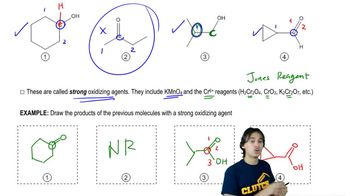
Predict the products of the reactions of the following compounds with: 1. chromic acid or excess sodium hypochlorite with acetic acid. 2. PCC or NaOCl (1 equivalent) with TEMPO. d. cyclohexanone
Verified step by step guidance
1
Step 1: Understand the nature of the reagents. Chromic acid (H₂CrO₄) and excess sodium hypochlorite (NaOCl) with acetic acid are strong oxidizing agents. PCC (pyridinium chlorochromate) and NaOCl with TEMPO are mild oxidizing agents. These reagents are used to oxidize alcohols or other functional groups depending on the substrate.
Step 2: Analyze the substrate, cyclohexanone. Cyclohexanone is a ketone, which is already in its most oxidized form for a simple carbonyl compound. Strong oxidizing agents like chromic acid or excess NaOCl will not further oxidize a ketone under typical conditions.
Step 3: Consider the reaction with PCC or NaOCl (1 equivalent) with TEMPO. These mild oxidizing agents are typically used to oxidize primary alcohols to aldehydes or secondary alcohols to ketones. Since cyclohexanone is already a ketone, no reaction is expected under these conditions.
Step 4: Summarize the expected outcomes. For both sets of reagents (strong and mild oxidizing agents), cyclohexanone is unlikely to undergo further oxidation because it is already a ketone, which is resistant to oxidation under normal conditions.
Step 5: Conclude that cyclohexanone remains unchanged when treated with the given reagents. This is an important concept in organic chemistry: ketones are generally stable to oxidation unless very harsh conditions are applied, which are not specified in this problem.
Verified video answer for a similar problem:
This video solution was recommended by our tutors as helpful for the problem above
Video duration:
1m
Play a video:
Was this helpful?
Key Concepts
Here are the essential concepts you must grasp in order to answer the question correctly.
Oxidation Reactions
Oxidation reactions involve the loss of electrons or an increase in oxidation state of a molecule. In organic chemistry, common oxidizing agents like chromic acid and sodium hypochlorite facilitate the conversion of alcohols to carbonyl compounds or further oxidize aldehydes to carboxylic acids. Understanding the nature of these reactions is crucial for predicting the products formed when specific compounds are treated with these reagents.
Pyridinium chlorochromate (PCC) and TEMPO (2,2,6,6-tetramethylpiperidinyl-1-oxyl) are selective oxidizing agents used in organic synthesis. PCC is often employed to oxidize primary alcohols to aldehydes without over-oxidation to carboxylic acids, while TEMPO is used for mild oxidation reactions, particularly in the presence of NaOCl. Recognizing their specific reactivity helps in predicting the outcomes of reactions involving these agents.
Functional group transformations refer to the chemical reactions that convert one functional group into another, altering the properties and reactivity of the compound. In the context of cyclohexanone, understanding how ketones react under different oxidation conditions is essential for predicting the final products. This concept is fundamental in organic synthesis, where the goal is often to modify compounds to achieve desired functionalities.